Tithonus though written in 1833, was not published till 1860, presumably because its mood and outlook were not in harmony with the more boyant and optimistic outlook of the poems in the 1842 volume.
Like Ulysses it is a dramatic monologue on a classical subject. It is based on the classical myth of the love of Goddess Aurora for Tithonus. Its story is told in the Homeric Hymn to Aphrodite. Tithonus, according to the myth, was beloved by Aurora, the goddess of the Dawn, who, at his request, made him immortal.
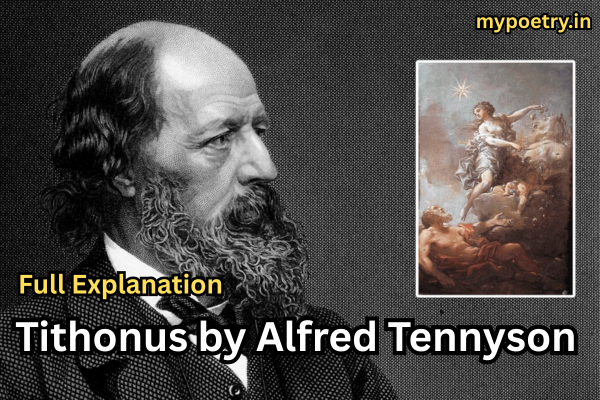
Since, however, he had omitted to ask for the perpetuation of his youth and beauty, he grew ever more and more old and decrepit, till, life becoming insupportable, he prayed Aurora to “take back her gift.” As he could not die, the goddess changed him into a grasshopper.
“The poem takes high rank in the quasi-dramatic division of Tennyson’s poetry, though it does not attempt to depict so much the characteristics of the individual as the special circumstances in which he is placed.” Tithonus is one of the poet’s most highly finished productions, and is remarkable for its purity of tone, its musical rhythm, and its simple beauty of style.
Full text
The woods decay, the woods decay and fall,
The vapours weep their burthen to the ground,
Man comes and tills the field and lies beneath,
And after many a summer dies the swan.
Me only cruel immortality
Consumes: I wither slowly in thine arms,
Here at the quiet limit of the world,
A white-hair’d shadow roaming like a dream
The ever-silent spaces of the East,
Far-folded mists, and gleaming halls of morn.
Alas! for this gray shadow, once a man—
So glorious in his beauty and thy choice,
Who madest him thy chosen, that he seem’d
To his great heart none other than a God!
I ask’d thee, ‘Give me immortality.’
Then didst thou grant mine asking with a smile,
Like wealthy men, who care not how they give.
But thy strong Hours indignant work’d their wills,
And beat me down and marr’d and wasted me,
And tho’ they could not end me, left me maim’d
To dwell in presence of immortal youth,
Immortal age beside immortal youth,
And all I was, in ashes. Can thy love,
Thy beauty, make amends, tho’ even now,
Close over us, the silver star, thy guide,
Shines in those tremulous eyes that fill with tears
To hear me? Let me go: take back thy gift:
Why should a man desire in any way
To vary from the kindly race of men
Or pass beyond the goal of ordinance
Where all should pause, as is most meet for all?
A soft air fans the cloud apart; there comes
A glimpse of that dark world where I was born.
Once more the old mysterious glimmer steals
From thy pure brows, and from thy shoulders pure,
And bosom beating with a heart renew’d.
Thy cheek begins to redden thro’ the gloom,
Thy sweet eyes brighten slowly close to mine,
Ere yet they blind the stars, and the wild team
Which love thee, yearning for thy yoke, arise,
And shake the darkness from their loosen’d manes,
And beat the twilight into flakes of fire.
Lo! ever thus thou growest beautiful
In silence, then before thine answer given
Departest, and thy tears are on my cheek.
Why wilt thou ever scare me with thy tears,
And make me tremble lest a saying learnt,
In days far-off, on that dark earth, be true?
‘The Gods themselves cannot recall their gifts.’
Ay me! ay me! with what another heart
In days far-off, and with what other eyes
I used to watch—if I be he that watch’d—
The lucid outline forming round thee; saw
The dim curls kindle into sunny rings;
Changed with thy mystic change, and felt my blood
Glow with the glow that slowly crimson’d all
Thy presence and thy portals, while I lay,
Mouth, forehead, eyelids, growing dewy-warm
With kisses balmier than half-opening buds
Of April, and could hear the lips that kiss’d
Whispering I knew not what of wild and sweet,
Like that strange song I heard Apollo sing,
While Ilion like a mist rose into towers.
Yet hold me not for ever in thine East:
How can my nature longer mix with thine?
Coldly thy rosy shadows bathe me, cold
Are all thy lights, and cold my wrinkled feet
Upon thy glimmering thresholds, when the steam
Floats up from those dim fields about the homes
Of happy men that have the power to die,
And grassy barrows of the happier dead.
Release me, and restore me to the ground;
Thou seëst all things, thou wilt see my grave:
Thou wilt renew thy beauty morn by morn;
I earth in earth forget these empty courts,
And thee returning on thy silver wheels.
The Story: The Elegiac Note
The tone of the poem is elegiac. Arthur Hallam is already dead, and his death has cast the dark shadow of grief on the poet’s soul, and it is the grief within him that inspires the tragic tone of the poem. Tithonus has grown old, “a White-haired ghost roaming like a dream”. He does no longer have his previous glory, he is a mere shadow of his former self, while Aurora still continues to be young and beautiful. Pathetically, he exclaims that he is, “Immortal age besides immortal youth,” and this companionship cannot endure for any length of time. He no longer feels the youthful sensation which Aurora’s youth and beauty inspired in him earlier; his blood does no longer glow with passion at the sight of her beautiful cheeks and shoulders.
Therefore, he asks the goddess to take back the gift of immortality she has granted to him, and put him back on earth, so that he too may die like other ‘happy man’ there. To Tithonus, broken and decrepit with age, men in their mortality appear to be happy for they can shake off their worn out physical selves, and thus renew their youth and vigour, while he himself is condemned to eternal immortality and so also to eternal old age and weak and shadowy existence.
The Moral
At his lament Aurora weeps, and Tithonus at once realises thatiGods themselves cannot recall their gifts”. Even if she wishes to restore him to his happy human condition, she cannot do so. Her tears frighten him for they remind him of her helplessness and his own eternal suffering as an old man.
The poem teaches us the truth that man should not desire to, “vary from the kindly race of men”, nor seek to, “pass beyond the goal of ordnance.” The poet does not rail cynically at human life, nor does he condemn it as worthless, as a mere, “orchestra of victim shriek and pain,” rather he is aware of the good and beauty in life, of, ‘the kindly race of man,’ and all the pleasures that lie open to him in this world.
But he wants that the limitations of human life should be accepted, for any desire to circumvent them is likely to result in divine punishment as in the case of Tithonus. Thus the poem is neither an expression of a death-wish, nor a condemnation of life, condemnation of life, nor is it a poem of escape, but a powerful plea for an acceptance of life with all its beauty and glory, as well as with all its limitation. Death is not to be shunned as something evil, but to be welcomed as the means through which life renews itself.
As a work of Art
Tithonus is a highly wrought work of art. Says J.B. Steane, “The poem is one of the most beautiful Tennyson ever wrote. What does seem significant and characteristic is that the best poetry should again be drawn from him by just such a subject. For Tithonus, though existing in perfect stillness, remote, as the lotos eaters, from the turmoil of ordinary life, has no will, no energy.
His condition makes it possible for the poet to recapture that Keatsian mood, ‘half in love with easeful death’, which had inspired him to write his best poetry in Mariana. He never wrote better than in the first lines of Tithonus.
The woods decay, the woods decay and fall,
The vapours weep their burthen to the ground,
Man comes and tills the field and lies beneath,
And after many a summer dies the swan.
Sound and image combine to enforce sense: to represent age and the sorrows of age, natural law and the beneficence of it. The heavy, regular beat of,
Man comes and tills the field and lies beneath
emphasises the kindly security that the natural rhythm of existence brings to the normal man. Aldous Huxley asks what the swan is doing in the picture and calls it a ‘luminous irrelevance’. F.L. Lucas has answered him saying that it is not: it is a symbol of age, and its whiteness, too, reflects the ‘white-hair’d shadow’ that the old man now is, sitting,
Here at the quiet limit of the world,
in either case, as Huxley says. “Tennyson knew his magician’s business.”
Imagery: Word-pictures
It has been said that Tennyson’s poetry lives by virtue of his imagery, and the poem amply illustrates the truth of this statement. Sensuous word-pictures, vivid and graphic, abound in the poem. For example, there are the two pictures depicting the rise of dawn and the gradual brightening of the eastern Horizon. We get a touch of kids like voluptuousness when the poet speaks of Aurora’s pure brows, bear, shoulders, and bosoms, her crimson cheeks, her dark eyes and her kisses, “Balmier than half-opened buds of April.” His eye for colour is seen in lines like the following;
And shake the darkness from their loosen’d manes,
And beat the twilight into flakes of fire.
Language and Diction
The poem is also remarkable for its felicity of expression, and provides numerous examples of Tennyson’s capacity to chisel, “jewels five words long” Expressions, like the following, have become current coins:
- A white-haired shadow roaming like a dream
- Immortal age, besides immortal youth.
- Kindly race of men
- Kisses balmier than half-opened buds.
- Happy men that have the power to die.
Conclusion
The poem, in short, “is perhaps the most perfect specimen of poetic workmanship in all Tennyson.” It does not give us a striking sketch of character like Ulysses; rather it is a study of an emotion and its circumstances, and as such it remains unsurpassed in Tennyson’s gallery of exquisite lyrics.