Discover the meaning and analysis of Ted Hughes’s “Jaguar,” exploring themes of captivity versus freedom, primal energy, and untamed wildness.
The apes yawn and adore their fleas in the sun.
The parrots shriek as if they were on fire, or strut
Like cheap tarts to attract the stroller with the nut.
Fatigued with indolence, tiger and lion
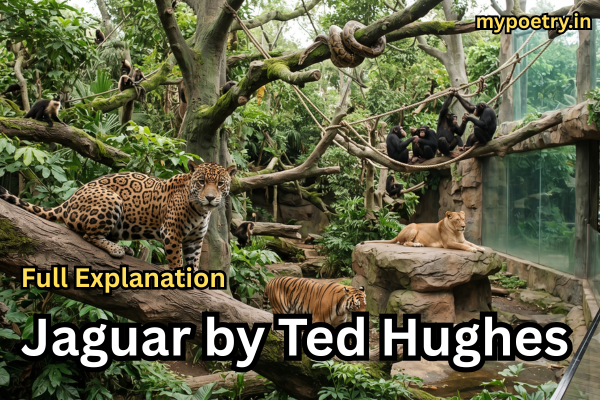
In this opening section of the poem, the speaker describes the dull, monotonous, and lethargic atmosphere of a zoo on a lazy afternoon. The zoo animals have surrendered entirely to their captivity, showing no signs of their wild, natural energy. This section serves as a foil or contrast to build anticipation for the fierce, untamed jaguar that appears later.
The apes are completely subdued, lazily yawning and picking fleas in the sunlight. The parrots behave frantically and artificially—screaming as if on fire or strutting “like cheap tarts” merely to beg for food from visitors (“the stroller with the nut”).
The majestic big cats, the tiger and the lion, are described as being “fatigued with indolence” (exhausted by laziness and inactivity). Instead of displaying power, they lie around listlessly, completely broken by their confinement.
Lie still as the sun.The boa-constrictor’s coil
Is a fossil.Cage after cage seems empty, or
Stinks of sleepers from the breathing straw.
It might be painted on a nursery wall.
In this stanza, the speaker continues to describe the lifeless, stagnant, and motionless atmosphere of the zoo. Building on the listless behavior of the apes, parrots, tiger, and lion in the first stanza, the speaker extends this heavy lethargy to the reptiles and the overall appearance of the enclosures, highlighting an environment completely stripped of dynamic, wild energy.
This stanza deepens the theme of confinement and spiritual death. By framing the zoo as a static “nursery wall” painting, Hughes emphasizes how captivity neutralizes the majesty of wild animals. This deadened, artificial backdrop serves to heighten the dramatic impact of the fierce, pacing jaguar, which breaks the monotony later in the poem.
But who runs like the rest past these arrives
At a cage where the crowd stands, stares, mesmerized,
As a child at a dream, at a jaguar hurrying enraged
Through prison darkness after the drills of his eyes
In this final stanza, the poem shifts dramatically from the dull, lifeless atmosphere of the earlier enclosures to a point of intense energy and fascination. While most visitors rush past the inactive animals (“runs like the rest”), someone stops at a specific cage, breaking the monotonous routine of the zoo.
This concluding stanza delivers the core message of the poem: true wildness cannot be entirely broken by confinement. While the other animals have surrendered to apathy, the jaguar maintains its fierce, burning energy. Its relentless movement and piercing eyes symbolize an unyielding spirit and internal freedom that outshines the artificial boundaries of captivity.
On a short fierce fuse. Not in boredom—
The eye satisfied to be blind in fire,
By the bang of blood in the brain deaf the ear—
He spins from the bars,but there’s no cage to him
In this stanza, the poem focuses intensely on the internal state and explosive physical movement of the jaguar. While the previous stanza introduced the crowd’s mesmerized reaction to the pacing animal, this section dives directly into the jaguar’s fiery, psychological world, contrasting sharply with the listless apathy of the other zoo animals.
This stanza delivers the thematic core of the poem: the triumph of spirit over physical confinement. While the zoo has reduced other animals to broken shadows of their former selves, the jaguar’s fierce internal energy and mental freedom render its physical cage irrelevant. It remains truly wild, untamed, and liberated in its own mind.
More than to the visionary his cell:
His stride is wildernesses of freedom:
The world rolls under the long thrust of his heel.
Over the cage floor the horizons come.
In this final stanza, the poem reaches its philosophical and imaginative peak. Having established the jaguar’s intense, fiery energy in the previous lines, the speaker now describes how the animal’s powerful internal freedom completely transcends its physical boundaries, expanding far beyond the confines of the zoo.
This concluding stanza delivers the ultimate thematic statement of the poem: the triumph of the untamable spirit over physical imprisonment. While ordinary visitors and the other zoo animals are trapped in mundane reality, the jaguar’s fierce vitality allows him to recreate the entire wilderness inside his mind, proving that true freedom is a state of being that no cage can truly destroy.
Download this poem in pdf format from here – Download pdf