Explore Ted Hughes’s “Thistles.” Discover how the poet uses prickly weeds as a powerful metaphor for human conflict, resilience, and endless cycles of war.
Full text
Against the rubber tongues of cows and the hoeing hands of men
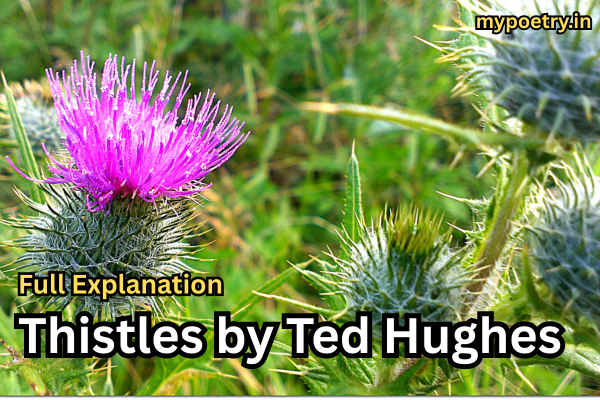
Thistles spike the summer air
And crackle open under a blue-black pressure.
Every one a revengeful burst
Of resurrection, a grasped fistful
Of splintered weapons and Icelandic frost thrust up
From the underground stain of a decayed Viking.
They are like pale hair and the gutturals of dialects.
Every one manages a plume of blood.
Then they grow grey like men.
Mown down, it is a feud. Their sons appear
Stiff with weapons, fighting back over the same ground.
Summary
While the cows are busy eating the grass growing on the ground, and the men are busy doing their agricultural work, thistles may be seen bursting into life under a natural pressure. Every thistle seems to have come into life with a revengeful motive. Every thistle seems to be like a human fist holding a weapon like the northern sea-robbers of the eighth, ninth, and tenth centuries. Every thistle reminds us of some Viking who lies buried underneath, and whose body has by now been reduced to dust. Every thistle seems to have a touch of blood about it, thus strengthening the impression that each thistle is a Viking who has come back to life in order to wage war once again. In course of time each thistle will turn grey, just as human beings turn grey with the passing of years. When these thistles have eventually been cut down, the battle would not come to an end. More thistles would grow, and they too would look like warriors, fully armed, and fighting over the same ground. It is with thistles as with men. The old generation dies out, and a new generation takes its place.
Critical Appreciation: Vivid Imagery Through Figurative Language
In the case of this poem, as in that of many other poems by Hughes, we find vivid imagery as the most conspicuous feature, though the imagery, as in most other cases, is of an unusual kind and is built up by means of an abundant use of metaphorical language. Thus the phrase “the rubber tongues of cows”, while conveying to us the idea of the softness of cows’ tongues, contains the word “rubber” as a metaphor. Then the line “thistles spike the summer air” contains the word “spike” which here is used metaphorically to convey the idea of the thistles rising sharply into the air.
Next, the word “resurrection” is used metaphorically for what the poet regards as a revival of the plants known as thistles; and then the poet uses a simile to convey to us the special qualities of this plant: “They are like pale hair and the gutturals of dialects.” The phrase “a plume of blood” in the next line is again a metaphor because the literal meaning of the word “plume” is a decoration worn by a warrior in his helmet.
Some comments by Critics on this Poem
Hughes means to say that the original grain of his speech is derived from what is known as Middle English, and that he is not sowing a new plant but only developing a new bud on an old bough. However, we, as Indians, will find it hard to understand this technical aspect of the poem before us, though we can well understand the idea that the thistles remind the poet of the warriors of olden times, and that the thistles look like warriors fighting over the same ground where the original Norsemen had fought. Two other critics* have some more illuminating comments to offer so far as this poem is concerned.
According to them, Hughes has built up a myth in this poem, as he has done in several other poems, such as Sugar Loaf, The Bear; Gog; Wodwo; and Ghost Crabs. In each case, these critics say, the myth represents a primeval, greater, and more relevant reality. These critics then go on to say that few of Hughes’s best poems are entirely without humour, and that Thistles has certainly much humour in it. The humour here, as in many other poems, arises from the shock which we experience on finding some aspect of Nature being brought into a relationship with human beings.
It is the anthropological element in this poem which makes it amusing for us. Other poems which have a similar anthropological element are Sugar Loaf, Fern, Skylarks, Gnat-Psalm, Full Moon and Little Frieda. In each of these cases, say our critics, anthropologism takes an unexpected turn in the final stanza, and we find ourselves thinking of human tragedy as a metaphor for a natural process, not the other way round. In Thistles, then anthropologism and wit go hand in hand, as in the poems already named.
Read more poem here – Paper 204 All poems Full details and explanation