A.K. Ramanujan’s “Obituary” reflects on a father’s death, family responsibilities, cultural rituals, memory, and the ironic reduction of a human life to debts, ashes, and newspaper lines. A brief analysis of A.K. Ramanujan’s “Obituary,” exploring death, family relationships, cultural rituals, memory, and loss.
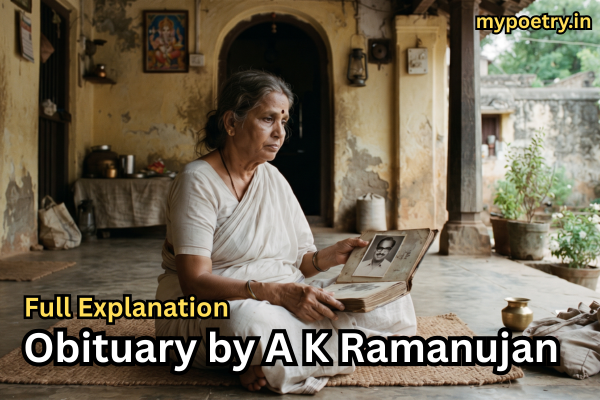
Full text with explaination
Father, when he passed on,
left dust
on a table of papers,
left debts and daughters,
a bedwetting grandson
named by the toss
of a coin after him,
Main idea – These lines show that death leaves behind practical problems and ordinary memories rather than only sadness. The father’s “legacy” consists of dust, papers, debts, daughters, and a young grandson. Through irony and simple details, Ramanujan presents death as part of everyday family life.
In this stanza, the speaker describes what his father left behind after dying. He left dusty papers, unpaid debts, daughters who needed care, and a young grandson named after him by the toss of a coin. The stanza presents death realistically and ironically. Instead of praising the father’s achievements, the poet focuses on the ordinary burdens and responsibilities left to the family.
a house that leaned
slowly through our growing
years on a bent coconut
tree in the yard.
Being the burning type,
he burned properly
at the cremation
Main idea – The stanza combines sadness with dark humour. The father leaves behind a damaged house, and even his personality is remembered through the word “burning.” Ramanujan avoids sentimental praise and presents death, poverty, family life, and cremation in a direct and ironic manner.
In these lines, the poet says that his father left behind an old house that had gradually become weak and leaned against a bent coconut tree. The house represents the family’s poverty and difficult life. The phrase “burning type” suggests that the father was hot-tempered or internally troubled. The poet then uses a pun: the father “burned properly” at the cremation, where “burned” literally refers to the cremation of his body.
as before, easily
and at both ends,
left his eye coins
in the ashes that didn’t
look one bit different,
several spinal discs, rough,
some burned to coal, for sons
Easy explaination – In these lines from A. K. Ramanujan’s “Obituary,” the poet describes what remained after his father’s cremation. He uses simple details, Hindu funeral customs, and dark humour to show that only a few physical objects were left behind.
Main idea – The stanza presents cremation as a physical and ordinary process. Only coins, ashes, spinal discs, and pieces of coal remain after the father’s death. Ramanujan’s detached description creates irony and shows that death reduces a person’s body to a few lifeless remains.
After the cremation, the father’s body burned easily and completely. Coins that had been placed on his eyes were found in the ashes. Some rough pieces of his backbone and parts burned into coal were also left behind. The sons had to collect these remains. The poet describes the funeral realistically and ironically, showing that after death a human body becomes only ashes and a few physical fragments.
to pick gingerly
and throw as the priest
said, facing east
where three rivers met
near the railway station;
no longstanding headstone
with his full name and two dates
In these lines from A. K. Ramanujan’s “Obituary,” the poet describes the final funeral ritual and explains that his father would not have a permanent memorial. The tone remains simple, factual, and slightly ironic.
Main idea – The sons complete the funeral according to the priest’s instructions, but the father receives no permanent memorial. His ashes disappear into the river, and his memory may survive only in the family and in the poem. Ramanujan suggests that an ordinary person may leave no stone monument behind, yet poetry can give him a lasting remembrance.
The sons carefully collect the father’s remains from the ashes and throw them into the meeting point of three rivers according to the priest’s instructions. They face east while performing this religious ritual. The place is near a railway station, which combines ordinary modern life with traditional customs. The father has no permanent headstone bearing his full name and birth and death dates, suggesting that he lived an ordinary life without public fame.
to holdin their parentheses
everything he didn’t quite
manage to do himself,
like his caesarian birth
in a brahmin ghetto and his death by heart
failure in the fruit market.
The poet says that the father’s whole life could have been written between two dates—his birth and his death. The lines are serious but also contain irony and dark humour.
Main idea – The poet presents the father’s entire life through two unusual events: a Caesarean birth and death from heart failure in a fruit market. The father could not control either event. The lines suggest that human beings do not control the beginning or end of life, and that an ordinary life may be remembered through small, unexpected details rather than through a grand monument.
The poet says that if his father had a headstone, the two dates on it would enclose everything he could not do himself. He could not control his Caesarean birth in a Brahmin neighbourhood, nor his death from heart failure in a fruit market. These lines are ironic and humorous because no person can control their own birth or death. They also show that the father lived and died like an ordinary man, without a grand memorial.
But someone told me
he got two lines
in an inside column
of a Madras newspaper
sold by the kilo
exactly four weeks later
to street hawkers
In these lines from A. K. Ramanujan’s “Obituary,” the speaker learns that his father’s death was mentioned in a newspaper. However, the notice was very short, hidden, and soon treated as waste paper.
Main idea – The father received only a small and hidden newspaper obituary. After four weeks, the newspaper was sold as waste paper by the kilo. Ramanujan uses irony to show how briefly society remembers an ordinary person. The father’s public memorial is reduced to two lines printed on paper that soon becomes part of daily commercial life.
The speaker hears that his father’s death was mentioned in two lines of an inside column of a Madras newspaper. The notice was not prominent because it did not appear on the front page. Four weeks later, the newspaper was sold by weight to street hawkers as waste paper. These lines show the short-lived nature of public memory and the insignificant place given to an ordinary man after his death.
who sell it in turn
to the small groceries where I buy salt,
coriander,
and jaggery
in newspaper cones
that I usually read
In these lines from A. K. Ramanujan’s “Obituary,” the old newspaper containing the father’s obituary is reused to wrap grocery items. The speaker later reads the same newspaper while buying household goods.
Main idea – These lines show how the father’s obituary passes from the newspaper to street hawkers, then to grocery shops, and finally into the speaker’s hands. The father’s death becomes connected with everyday objects such as salt, coriander, and jaggery. Ramanujan uses irony to show that a person’s public memory can be temporary and ordinary, while personal memory continues in unexpected ways.
The old newspaper containing the father’s obituary is sold to street hawkers and then to small grocery shops. The speaker buys salt, coriander, and jaggery wrapped in newspaper cones from these shops. He usually reads the paper used for wrapping and may see the two lines about his father’s death. The passage shows how the father’s memory survives accidentally in ordinary daily life.
for fun, and lately
in the hope of finding these obituary lines.
And he left us
a changed mother
and more than
one annual ritual.
These are the final lines of A. K. Ramanujan’s “Obituary.” The speaker explains why he reads old newspaper cones and then describes the lasting effects of his father’s death on the family.
Main idea – The speaker first reads newspaper cones for fun, but later reads them in the hope of finding his father’s obituary. This reveals his continuing emotional connection with his father. In the end, the father’s real legacy is not a monument or a famous obituary but a changed wife, family memories, and annual rituals.
The speaker usually reads the newspaper cones used for wrapping groceries for fun. Recently, he reads them hoping to find the two obituary lines about his father. This shows that he still remembers and misses him. The father’s death changed the mother and left the family with several annual religious rituals. Thus, the father’s lasting legacy is found in the family’s changed life, memories, and customs rather than in a permanent monument.
Read more poems here – mypoetry.in
Download this poem in Pdf format –