An Introduction
The Genesis of “The Battle of the Books”
The Battle of the Books is a satirical work which Swift wrote with a definite purpose. His purpose was to lend support to his patron, Sir William Temple, in the position which Temple had taken up with regard to the controversy about ancient and modern learning. A controversy on this subject had been going on in France for some time. Two French writers, Charles Perrault and Bernard Fontenelle, had given high praise to modern writers and had written in a disparaging manner about the ancient authors. In 1692, Temple introduced the controversy into England by publishing an essay on ancient and modern learning. In this essay, Temple tried to demonstrate the superiority of ancient authors over modern authors, especially commanding two writers, namely Phalaris and Aesop. Temple’s view was challenged by William Wotton who in his Reflections On Ancient and Modern Learning asserted that Temple’s approach to the subject was wrong. Wotton’s essay appeared in 1694. In 1695 a scholar by the name of Charles Boyle (who afterwards became the Earl of Orrery) published an edition of the Letters of Phalaris. In the same year Wotton brought out another edition of his previous essay written under the title of Reflections On Ancient and Modern Learning re-asserting his previous stand that the Ancients were not superior to the Moderns and also doubting the authenticity of the letters attributed to Phalaris. At this stage, Richard Bentley, the keeper of the King’s libraries, entered the fray. He wrote a Dissertation on the Letters of Phalaris and added it to the second edition of Wotton’s book in the form of an Appendix. In this Dissertation, Bentley adduced several historical facts to prove that the Letters attributed to Phalaris could not have been written by that man. According to Bentley, while Phalaris, the tyrant of Agrigentum, flourished during the 6th century B.C., the contents of the Letters attributed to him pertained to a period three centuries later. In other words, Bentley expressed his firm view that the Letters of Phalaris were spurious. Bentley also expressed the view that the fables or animal stories attributed to Aesop had been written not by Aesop but by somebody else belonging to a later period of time. As Boyle wrote a reply to Bentley’s Dissertation, Bentley was compelled to bring out an enlarged edition of his Dissertation which appeared in 1699. To this enlarged Dissertation, Boyle wrote yet another reply.
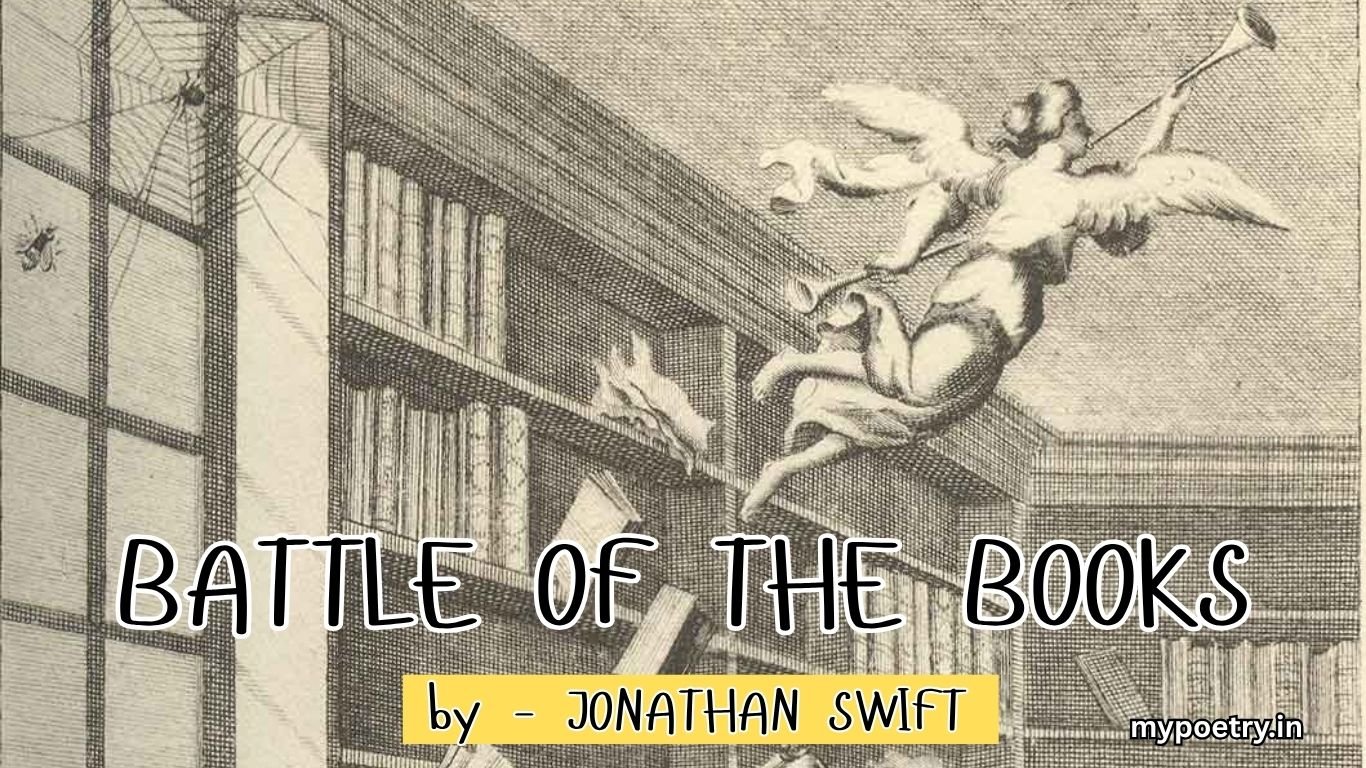
“The Battle of the Books”, An Allegory
Swift wrote The Battle of the Books largely in 1697 though it appeared in book form along with A Tale of a Tub in 1704. Swift, in his endeavour to uphold Temple’s point of view, pours contempt and ridicule upon the Moderns and tries to establish the superiority of the Ancients. But he does not offer any formal arguments to demolish the case of the Moderns, and to exalt the Ancients. Making use of the allegorical mode of expression, he imagines that a dispute takes place in a library between the books written by the Moderns and the books written by the Ancients and that soon afterwards the dispute develops into a regular battle between the two parties of books.
Actually, however, Swift wishes to convey to us the two opposite points of view which in his time were being emphatically put forward by scholars on the subject of ancient and modern learning. Some scholars tended to magnity the achievements of modern authors, while others insisted that the ancient writers and their wisdom could not be surpassed or excelled by the Moderns.
Wotton and Bentley belonged to the former faction, while Sir William Temple and Boyle represented the opposite point of view. Swift adopted Temple’s point of view and wrote The Battle of the Books to establish the superiority of ancient learning in all its branches over modern learning. One particular episode in The Battle of the Books is especially remarkable for its allegorical character. The spider-and-the-bee debate in this book has a special bearing on the controversy about ancient and modern learning, and is Swift’s principal’s contribution to that controversy. The spider here symbolizes the Moderns, while the bee represents the Ancients. The allegorical significance of this debate is clearly brought out by Aesop who comments upon the debate and points out that the remarks made by the spider and the bee respectively should be regarded as having come from the Moderns and the Ancients respectively.
According to this interpretation, the Moderns are narrow-minded and are bound by pedantic rules as a result of which their writings largely contain poison, while the Ancient used to collect their materials from far and near and have filled, their writings with honey and wax which are a source of sweetness and light for the world. The spider-and-the-bee episode is one of the highlights in The Battle of the Books.
Targets of Satire in “The Battle of the Books”
The satirical vein runs through The Battle of the Books from beginning till the end. The whole tract or essay is permeated by a satirical purpose. In the very Preface, Swift writes satirically about writers who have shallow brains and who make the mistake of provoking superior brains by their impertinence. The tract proper also begins satirically when Swift compares a republic of human beings to a republic of dogs in which some leading dog catches hold of a large bone or manages to bring a bitch under his control, thereby arousing the jealousy and resentment of the other dogs who have got neither a bone nor a bitch. Then Swift goes on to satirize the writers of “books of controversy” which, as they lie on the shelves of a library, tend to quarrel and fight with one another. The next target of his satire is Richard Bentley who was the keeper of St. James’s Library at the time. The Moderns are then satirized as a group by being represented through the spider all whose claims are applicable to them. Swift then proceeds to satirize the individual modern authors by showing them as getting involved in armed fights with ancient authors and being humiliated or killed by them. The killings here symbolize the utter defeat of the Moderns at the hands of the Ancients, and a convincing proof of their inferiority to the Ancients. The individual authors who are thus satirized and subjected to ridicule are Descartes, Sir William Davenant, Sir John Denham, Samuel Wesley, Charles Perrault, Bernard Fontenelle, Richard Blackmore, Thomas Creech, John Oldham, Abraham Cowley and, above all, Dryden.
The Battle of the Books concludes with a biting satire on two men who were supposed to be the greatest opponents of the Ancients. These two men were Bentley and Wotton who meet a disgraceful end at the hands of Charles Boyle. One other target of satire in The Battle of the Books is Criticism which is personified by Swift as a goddess. The goddess Criticism is depicted in such a manner that destructive critics as a class fall greatly in our estimation. The portrayal of the goddess Criticism is one of the satirical highlights in this book and ranks with the satirical portrayal of Bentley
“The Battle of the Books”, A Mock-Epic or Mock-Heroic in Prose
The most conspicuous feature of The Battle of the Books is the mock-epic or mock-heroic mode of writing which Swift here adopts. An epic deals with the deeds of a great hero in a lofty or dignified style, while a mock-epic is a parody of the epic, using a dignified style to deal with a trivial or mean subject. In the present case Swift presents books (or their authors) as fully armed warriors who clash with one another in single combats like those described by Homer and Virgil in their well-known epic poems (the Iliad and the Aeneid respectively). The encounters are described in a tone of mock gravity, and Swift also makes use of supernatural machinery for comic effect.
He follows, too, the epic convention of using similes which, however, instead of lending dignity to the writing serve to heighten the comic effect.
Satirical Humour in “The Battle of the Books”
Humour is an indispensable element in all true satire. Of course, in the hands of certain writers, satire often takes the form of abuse or invective.
Swift himself resorts to denunciation in the past part of his satirical work, Gulliver’s Travels. But all genuine satire must amuse the readers by its use of humour, wit, irony, raillery, mockery, sarcasm, etc. Swift is one of the greatest humorists in the English language, and The Battle of the Books provides abundant evidence of his humour. Indeed, satirical humour is the keynote of The Battle of the Books. The portrayal of Bentley is an outstanding example of Swift’s satirical humour. This man is depicted as light-headed and, though wonderfully agile in speculation, he has such a heavy back that he is unable to climb the rock where two of the ancient chiefs occupied a certain position.
Bentley is described as a man with a confused mind, the confusion being due to the fact that he had swallowed a large number of worms from the books of some medieval philosophers and theologians. The portrayal of Dryden provides another example of Swift’s satirical humour. Dryden’s helmet is nine times too large for his head which was situated far in his hinder part,
“like the lady in a lobster, or like a mouse under a canopy of state, or like a shrivelled beau from within the penthouse of a modern periwig”. Then, of course, there is the satirical portrayal of the goddess Criticism.
The Characters in “The Battle of the Books”
A very large number of ancient and modern writers figure in The Battle of the Books. Among them, of course, are the leaders on the two sides of the controversy about ancient and modern learning. The champions of ancient learning are Sir William Temple and Charles Boyle. The champions of the Moderns are Richard Bentley and William Wotton. Then there are the authors or the warriors who take part in the so-called battle. Those who represent the Ancients are: Homer; Pindar; Euclid; Plato and Aristotle; Herodotus and Livy; Hippocrates and Galen. The list of the Moderns is much longer and includes the following: Paracelsus; Descartes; Davenant; Denham; Wesley;
Perrault; Fontenelle;, Dryden; Blackmore; Creech; Oldham; Afra Behn; and Cowley. Then there are a few supernatural characters also as part of the epic frame-work. These deities include Jupiter or Jove, Apollo, Pallas, Momus, and Mercury.
| Category | Ancients | Moderns |
|---|---|---|
| Champions | Sir William Temple, Charles Boyle | Richard Bentley, William Wotton |
| Warriors | Homer, Pindar, Euclid, Plato & Aristotle, Herodotus & Livy, Hippocrates & Galen | Paracelsus, Descartes, Davenant, Denham, Wesley, Perrault, Fontenelle, Dryden, Blackmore, Creech, Oldham, Afra Behn, Cowley |
| Deities | – | Jupiter (Jove), Apollo, Pallas, Momus, Mercury |
The Argument in Brief
As has been made abundantly clear above, Swift in The Battle of the Books appears as a strong advocate of ancient learning and ancient authors. His main argument in favour of the Ancients is conveyed to us throughthe allegory of the spider and the bee. The Moderns claim that they are original in their productions and that they have borrowed nothing from other sources.
This claim, according to Swift, only shows the narrow-mindedness, superficiality, and egoism of the Moderns. Much of the work of the Moderns contains little more than wrangling and satire, and is therefore like the poison which the spider draws from its own inner self. The Moderns do possess
“method and art”, but they do not have “duration and matter”. The Moderns are hide-bound, and the slaves of pedantic rules. They are pretentious in their learning and wish to make a parade of what little learning they possess. The Ancients, on the contrary, have furnished in mankind with the two noblest of things, which are sweetness and light. Thus The Battle of the Books becomes a satire on pedantry, pretentiousness, false erudition and subjectivism. The encounters, in which the Moderns are easily vanquished by the Ancients, are so described as to glorify the Ancients and to degrade and ridicule the Moderns. The closing episode in the book depicts the triumph of Charles Boyle (and Temple) over Wotton and Bentley in the controversy about the relative claims of the Ancients and the Moderns to superiority.
The Loose Structure of “The Battle of the Books”
Although The Battle of the Books is a masterpiece of satirical writing, its construction leaves much to be desired. There is a glaring lack of continuity in the narration of events. Swift begins in a somewhat didactic vein by finding the source of wars in poverty and want, the implication being that the Moderns started a war against the Ancients because of their own intellectual poverty and the feeling of jealousy to which it gave rise. He then gives us the origin of the dispute between the Moderns and the Ancients by describing the two groups as tenants on Parnassus, the former occupying a lower summit than the one in the possession of the latter. Then there is a digression in which Swift makes a satirical attack on Richard Bentley (who had disproved Sir William Temple’s views about the Epistles of Phalaris. Next, Swift turns to the books of the Moderns who were taking stock of their strength and their resources and who were not at all convinced by one of the Ancients trying to assert the superiority of the Ancients. This is followed by the allegory of the spider and the bee. The commanders of the armies of the Moderns and the Ancients are then named. There is another digression when a reference is made to the conference of gods and goddesses above in the heavens (on the Milky Way and when several paragraphs are devoted to a portrayal of the goddess Criticism. All this takes a little more than half of Swift’s book and it is only then that the battle, consisting of several successive encounters, begins. The closing encounter is, again, disproportionately long, evidently because Swift wanted to make Bentley and Wotton the principal targets of his satirical attack. Another flaw in the construction is, the several gaps in the narration indicated by dots and a note in Latin that something is missing What was Swift’s purpose in making it seem that something was missing, nobody knows. Nor is it clear why Latin wording is used every time there is a gap. The gaps merely puzzle and irritate the reader.
A Synopsis
The Leaders in the Controversy
The Battle of the Books contains a satirical account of the controversy that had been going on for some time in England with regard to the comparative merits of the ancient authors and modern authors. In this controversy Sir William Temple and Charles Boyle had emerged as the champions of the ancient writers and ancient learning, while William Wotton and Richard Bentley had taken up the opposite stand and had argued that the Modern were by no means inferior to the Ancients and that in fact the Letters attributed to Phalaris had not been written by Phalaris and that, likewise, the fables attributed to Aesop had been written not by Aesop but by somebocy else belonging to later times.
A Dispute Between Two Parties of Books
Swift wrote The Battle of the Books in order to support the thesis which had been put forward by his patron, Sir William Temple, who had claimed that the ancient authors were superior in wisdom and learning to the modern authors. Swift imagines that a dispute started among the books lying on the shelves of St. James’s Library in London. In this dispute the books written by modern authors claimed that they were superior to those written by ancient authors, while the books of the ancient authors made a counter-claim. Thus Swift gives a comic turn to the controversy. To imagine that a quarrel has occurred between books belonging to two different parties is certainly very amusing. Swift further imagines that the dispute between the two groups of books led to a regular battle, and so he proceeds to describe that battle. As Swift uses war-like phraseology in describing the combatants and the battle, we have here what is known as a mock-epic. In a serious or true epic, a real battle between heroes is described but here an imaginary battle between books is described in the kind of language which an epic writer would employ
in connection with a battle between warriors.
The Occupants of Two Summits on Parnassus
The origin of the dispute between the two parties of books is described by Swift in the very beginning in allegorical terms. He regards the ancient authors and the modern authors as the occupants of two summits of a mountain called Parnassus (which was sacred to Apollo and the Muses), the summit occupied by the Ancients being higher than the one occupied by the Moderns. A feeling of jealousy leads the Moderns to challenge the right of the Ancients to occupy the higher summit. It becomes obvious to us at this very point that Swift regards the Ancients as being superior to the Moderns. The quarrel between the occupants ofthe two summits, says Swift, then spread to the books lying on the shelves of St. James’s Library
An Attack on Bentley
Before describing the actual battle fought by the books, Swift takes the opportunity to attack Richard Bentley who was the keeper of the aforesaid library and who, we have noted above, was a champion of the Ancients. Swift satirizes Bentley for his discourtesy towards those who wanted to borrow books or manuscripts from the library and for his inability to think clearly or to keep the library books in a proper order.
No Compromise Between the Parties
Swift then turns to the books themselves and the dispute which was taking place between them. One of the Ancients, says Swift, had tried to settle the matter by arbitration but had failed in his effort to assuage the tempers. This ancient author had pointed out that the writers belonging to his side were really wiser than those of the modern times and that they were entitled to greater respect because of their antiquity. But the Moderns did not accept this argument and went so far as to claim that of the two parties the Moderns were the more ancient.
The Debate Between a Spider and a Bee
Swift then proceeds to describe an important event which occurred at this juncture. A bee, finding a hole in a broken window-pane of the library, came inside and landed upon a spider’s cobweb. This invasion by the bee led to a dispute between the two (the spider and the bee). The spider spoke to the bee in a contemptuous tone, pointing out that while he himself owned an impressive palace (namely, his cobweb), the bee had no property or substance at all except a pair of wings and a drone-pipe. The bee in reply said that heaven had given to him the power to fly and the power to sing, and that he visited all the flowers and the blossoms ofthe field and the garden, gathering the required materials for his use. The bee also alleged that the spider’s palace, while exhibiting “method and art”, was absolutely devoid of “duration and matter”. The bee went on to say that all that the spider produced was poison while the bee produced honey and wax.
The Allegorical Significance of the Debate
Now this quarrel between the spider and the bee is intended by Swift to be interpreted as having allegorical significance. Swift himself explains that states allegorical significance through the medium of Aesop who now speaks and the that whatever the bee had said in favour of himself could be applied to could ancient be authors and that whatever the bee had alleged against the spider real grounds applied for boasting to the Moderns. According to Aesop, the Moderns have no of their genius or their inventions because, even if they possess method and skill, they have only produced works which will soon be forgotten because the materials of which those works are made have come out of the authors themselves and are therefore no better than dirt. The Moderns cannot claim to any genuine productions of real value. Much in their work can be described as mere wrangling and satire which may be compared to the spider’s poison. As for the Ancients, they have their imaginative flights and their language. The Ancients collected their materials from every corner of Nature and they have produced works full of honey and wax which have contributed to mankind two of the noblest things, which are sweetness and light. Thus, according to Aesop, the Ancients have provided the light of knowledge and wisdom to mankind and have added sweetness to human relations.
The Names of the Commanders ofthe Two Armies
Swift then goes on to mention the books which took part in the battle. However, instead of naming the books by their titles, he names the authors of the books which took part in the fight. The Moderns had much difficulty in deciding upon their leaders. This difficulty was especially felt by those who had written epic poetry because in this field every one claimed to be the leader. The principal figures in this sphere among the Moderns were Tasso, Milton, Dryden, and Wither*. The non-epic poets were commanded by Cowley and Despreaux (or Boileau). The philosophers were led by Descartes, Gassendi, and Hobbes. The physicians were led by Paracelsus and Harvey. Then there were historians, under the command of Guicciardini, Davila, Polydore Virgil, Buchanan, Mariana, Camden, and others. The mathematicians were commanded by Regiomontanus and Wilkins. Then there was a confused multitude of fighters led by Scotus, Acquinas, and Bellarmine. And finally, there was a disorderly mob of camp-followers led by L’Estrange. The army of the Ancients was much smaller. The epic poets among the Ancients were led by Homer, and the non-epic poets by Pindar. Euclid led the mathematicians; Plato and Aristotle commanded the philosophers; Herodotus and Livy the historians; Hippocrates the physicians. The Ancients had also a couple of supporters from amongst the Moderns. These supporters were led by Vos of Leyden and by Sir William Temple.
Intervention By Jupiter
When the two armies of warriors had thus got ready for the battle, Fame, who had at one time an important position in the library, flew up straight to the chief god, Jupiter, and gave him a faithful account of what was happening below on the earth. Jupiter immediately called a meeting of the gods and goddesses in order to decide upon a course of action. However, there being a difference of opinion among the gods and goddesses, Jupiter privately consulted the Book of Fate and gave appropriate orders to his agents to go down to the library and manipulate events in accordance with those orders.
The Role of Momus and of Criticism
Momus, the god of jealous mockery, who at the conference of the gods and goddesses had taken the side of the Moderns, now enlisted the support of a goddess known as Criticism. This goddess was very malignant and she lent her full support to the Moderns. Swift here gives us a most amusing portrayal of the goddess called Criticism, bringing out the negative and destructive role which modern critics play under her patronage. One of her first actions on this occasion was to urge Wotton to start the fight with the Ancients without any further delay; and in order to enable him to do his job well she fed him with her own spleen—thus rendering him half-crazy.
Victories Won By Aristotle, Homer, Virgil
Swift then goes on to describe the battle itself. He tells us that the first to start the offensive was Paracelsus who attacked Galen with a javelin but who was himself wounded by Galen’s counter-attack. Then Aristotle shot an arrow at Bacon, but Bacon escaped being injured and the arrow hit and killed another modern philosopher whose name was Descartes. Now it was Homer’s turn to launch an attack upon the modern epic poets such as Sir William Davenant, Sir John Denham, and Samuel Wesley all of whom he killed without any difficulty. Nor did Homer stop till he had also killed the two Frenchmen, Charles Perrault and Bernard Fontenelle. What Swift means here is that the epic poems produced by the Moderns were worthless in comparison with Homer’s epic poetry. Next came Virgil, another ancient epіc poet. He found himself face to face with the modern poet, Dryden who also had attempted epic poetry (by writing a translation of Virgil’s Aeneid). Dryden, however, acknowledged Virgil’s superiority to himself as an epіс poet, and sought a compromise with the enemy.
The Attack By Lucan
Yet another ancient epic poet, by the name of Lucan, now attacked two Moderns who also had attempted epic poetry. These Moderns were Richard Blackmore and Thomas Creech. Blackmore was saved from death by the intervention of Aesculapius (the god of physicians) because Blackmore was by profession a physician though in his leisure time he wrote poetry. As for Creech, saved from he an chased evil a deceptive image of the ancient poet Horace and was fate by his patron, John Ogleby.
The Victories Won By Pinder
Then the such ancient modern poet, Pindar, the famous writer of Odes came forward Behn. Pindar then writers of Pindaric Odes as John Oldham and Afra Pindaric Odes and cut attacked Abraham Cowley who also had written some him into two parts. Venus, the goddess of love and beauty, however, did a special favour to the dead Cowley and changed onehalf ofhis body into a living dove.
The Mock-Epic and the Allegorical Technique of Writing
In describing these fights and killings, Swift has employed what is as the mock-epic style ofwriting. He imagines that the books or their authors are warriors who are fighting on a battle-field. Each author has been presented to us as fully armed and as attacking his foe very much as a real warrior on a battle-field would attack his adversary. The use of military terminology gives to the whole account an epic quality, but as this military language has been used in the context of books in a library, the account becomes mock-epic. Furthermore, the whole of this account of the battle and the killings which take place has an allegorical meaning. When, for instance, Homer kills several Moderns, Swift wants us to understand that the modern epic poets are worthless as compared to Homer. Similarly Dryden as an epic poet is presented as being for inferior to Virgil. Pindar’s killing some of the Moderns implies his great superiority over those who had tried to write Odes according to the technique he had invented. Creech running after the
deceptive shape of Horace simply means Creech’s incapacity to reproducе the spirit of Horace’s poetry in his translation of it.
The Last Episode: a Satirical Portrayal of Bentley and Wotton
Then comes the last episode in The Battle of the Books. The central figures in this last episode are Bentley and Wotton (who were the champions of the Moderns), and Temple and Boyle (the champions of the Ancients). Swift pours all his scorn and ridicule upon Bentley and Wotton. Bentley is described as the most deformed of all the Moderns, wearing an armour which was patched up of a thousand incoherent pieces, and carrying a flail in his right hand and a vessel full of excrement in his left hand, the flail and excrement being his weapons of offence. Swift also depicts Bentley as a malignant fellow scolding others without wit or truth or discretion, and as a fellow whose learning had made him even more barbarous than he originally was. In the company of Wotton, Bentley now looks for some enemy who can be attacked and killed without any danger to themselves. The two friends see Phalaris and Aesop lying fast asleep in the distance, but they do not have the courage to attack them. Wotton even fails in his attempt to quench his thirst at the spring known as Helicon. The two friends then encounter Charles Boyle who attacks them with a lance and kills both of them at one stroke. Through this mock-epic account Swift depicts both Bentley and Wotton as cowards, not having the courage to come to grips with their enemies, and being killed by a far more powerful man, namely Boyle. This is an allegorical way of saying that Bentley and Wotton had failed in their attempt to prove that Boyle and Temple were wrong in their support of the Ancients. According to Swift’s satirical account, then, Temple and Boyle had been victorious in their support of the Ancients as against Bentley and Wotton who had opposed the Ancients and given all their support to the Moderns. (However, we must remember that Swift himself is here wrong. Actually Bentley had fully succeeded in proving that the Letters attributed to Phalaris had not actually been written by Phalaris. Swift, on the other hand, shows Bentley as feeling afraid of attacking Phalaris and Aesop when he sees them lying fast asleep. Otherwise also Bentley and Wotton were by no means cowards because they had openly and boldly challenged the position taken up by Temple and Boyle)
Critical Summary
THE BOOKSELLER TO THE READERS
The Background of the Battle
The following account of the controversy on the subject of ancient and modern learning was written by the same author (namely, Swift) who had previously written a satire called A Tale of A Tub. The controversy originated from an essay written by Sir William Temple on that subject. Temple’s view had been challenged by Wotton who had been supported by Bentley. Temple had given high praise to Aesop and Phalaris. But Bentley had tried to prove that Aesop and Phalaris had not written the fables and the letters which had respectively been attributed to those two men. Bentley had, accordingly, criticized Charles Boyle’s new edition of the Letters of Phalaris on the ground that the letters were not authentic. Boyle had thereupon replied to Bentley’s criticism, but Bentley had subsequently published another attack upon Boyle for insisting on the authenticity of the letters.
Swift’s Account of the Battle
Swift felt offended to find the views of Temple challenged by Wotton and Bentley and, as this quarrel ultimately spread to the books in St. James’s Library and took the form of a battle, Swift decided to write an account of the battle.
THE PREFACE BY THE AUTHOR
The Inoffensive Nature of Satire in General
Satire on society or mankind in general does not hurt anybody because every reader thinks that it is not he who is being attacked but others. Even if somebody were to feel offended by reading this kind of satire, he would not be able to retaliate because, when a man feels angry, it is only his physical muscles which become stronger, while the muscles of his mind become feeble and ineffective.
A Shallow-Minded Person Versus a Man of Genius
There are some people who have shallow minds. Let such persons take care not to quarrel with those who have superior brains. A shallow-minded man may take the initiative in attacking one with a superior mind, but soon afterwards he will find himself in a most miserable condition as a result of the counter-attack by the man of genius. The mind of a shallow person, is quickly exhausted because it has very little knowledge in it.
A FULL AND TRUE ACCOUNT OF THE BATTLE FOUGHT LAST FRIDAY BETWEEN THE ANCIENT AND THE MODERN BOOKS
Wars, Started By the Poor Against the Rich (Paragraph 1)
Swift begins the essay called The Battle of the Books by expressing the view that disputes and wars are generally started by those who are needy and poor against those who are prosperous and well-to-do. He illustrates this remark from what he describes as the republic of dogs. If some leading dog in this republic takes possession of a large bone or of a bitch, the other dogs will feel jealous, and will feel a lot of resentment and indignation against the lucky dog.
Critical Note on Paragraph 1
Swift evidently expresses this view about war because he wants indirectly to convey to us the idea that the Moderns started a war against the Ancients on the ground that the former were lacking in those treasures of the mind which were in the possessions of the Ancients.
The Grievance of the Moderns (Paragraph 2)
Swift then goes on to speak of the disagreement which existed at that time between two great parties. The two great parties were the Moderns and the Ancients both of whom lived on a mountain called Parnassus (a mountain sacred to Apollo and to the Muses). It so happened that, from the earliest times, the Ancients had been living on a summit of Parnassus higher than the summit occupied by the Moderns. Now, the Moderns, realizing that they were at some disadvantage on account of the lower level at which they dwelt, proposed to the Ancients that either the Ancients should surrender the higher summit to the Moderns or that the Moderns should be allowed to make use of their tools to dig the higher summit of the Ancients and bring it down to the same level as the summit of the Moderns. In reply, the Ancients said that the better course for the Moderns would be to raise the level of their own summit instead of pulling down the summit of the Ancients because any attempt to pull it down would prove utterly futile. As no compromise between the two parties was possible, a quarrel began in which large quantities of ink were used by both parties in order to give vent to their rage, fury, and wrath. Much poison from the minds of the writers of both sides flowed through the ink on to the paper, and many books of bitter controversy were produced.
Disputes Between Books of Controversy (Paragraphs 3-4)
In these books of controversy, says Swift, the spirits of the warriors who wrote them dwell as long as the warriors or the writers themselves live in this world. However, sooner or later such books are entirely forgotten. Sometimes there are disputes between these books lying on the shelves of libraries. On one occasion there was a dispute between the books of Scotus and those of Aristotle on one side and the books of Plato on the other. In this dispute, the combined strength of Scotus and Aristotle dislodged Plato who had for many centuries occupied the supreme position in the library. The dispute which now arose between the Moderns and the Ancients on Parnassus led to the publication of a number of books imbued with a most malignant spirit.
Critical Note on Paragraphs 2-4
In Paragraphs 2-4, Swift describes the origin of the dispute in allegorical terms. He regards the Ancients and the Moderns as the occupants of two summits on Parnassus, one higher and the other lower. A feeling of jealousy leads the Moderns to challenge the right of the Ancients to occupy the higher summit. It is obvious that Swift regards the Ancients as being superior to the Moderns.
A Fight Between Two Parties of Books (Paragraph 5)
Swift then says that he had at the very outset anticipated trouble when he found that books by the Moderns and by the Ancients had been placed together in the library. His fear of a trouble proved well-founded when a terrible fight really broke out between the ancient and modern books in St.
James’s Library. Being fully qualified to write a true and impartial account of that battle, Swift decided to record the events of the battle in detail.
The Confusion in the Mind of Bentley (Paragraph 6)
Swift begins his account with a reference to the keeper of St. James’s
Library (a man by the name of Richard Bentley) who was well-known for his discourteous and sullen behaviour towards those who wanted to borrow books or manuscripts from the library. This man was a strong champion of the Moderns and a fierce opponent of the Ancients. His antagonism towards the Ancients had led him to make an attempt to knock down two of the ancient writers (Phalaris and Aesop) from their high positions. But his attack upon them had completely failed. Bentley was a shallow-minded and confused person who had betrayed an incapacity to maintain any order among the books in the library. His inability to think clearly had been responsible for the books by various authors lying together in a state of confusion instead of having been arranged, properly. The result of this confusion was that books by Descartes lay next to those of Aristotle, that the books of Plato lay between those of Hobbes and a book called Seven Wise Masters, and that the books of Virgil were sandwiched between those of Dryden and those of George Wither.
Critical Note on Paragraph 6
Swift takes the earliest opportunity to attack Richard Bentley, the keeper of St. James’s Library, because it was Bentley who had challenged Sir William Temple’s views by trying to prove that the letters attributed to Phalaris were forgeries and that the fables attributed to Aesop had been written by somebody else belonging to much later times. This paragraph contains a satirical sketch of Bentley, and amuses us because of the witty and sarcastic manner in which Swift has described Bentley.
The Moderns’ Claim to Originality (Paragraphs 7-9)
The Moderns now made a survey of their forces in the library. They found that there were fifty thousand of them in all, consisting chiefly of light-horse, heavy-armed foot, and mercenaries. It was also found that the forces of the Moderns were not well-equipped. As an exchange of hot words between the two parties had already started, one of the Ancients tried to settle the matter by arbitration. This ancient author pointed out that the writers belonging to his side were really wiser than those of the modern times and that they were entitled to greater respect because of their antiquity. But the Moderns did not accept this argument and went so far as to claim that of the two parties the Moderns were the more ancient. Nor did the Moderns admit that they owed any debt to the Ancients. The Moderns claimed that their horses were of their own breeding, that their weapons were of their own forging, and that their clothes were of their own cutting and sewing. This claim was so absurd that Plato, who happened to overhear it, burst into a loud, mocking laugh. At this point Sir William Temple, who had made a special study of the Ancients and who was their greatest champion left his place among the Moderns and went over to join the Ancients in their fight against the Moderns.
Critical Note on Paragraphs 7-9
The mock-epic character of Swift’s account now becomes more emphatic. (The mock-epic character of Swift’s satire is evident from the very title The Battle of the Books. The very notion that books can fight a battle has a mock-epic suggestion about it. Now Swift uses some military terms such as “light-horse”
“heavy-armed foot” and “mercenaries”. “Light-horse”
refers to the non-epic poets.
“Heavy-armed foot” refers to historians. And
“mercenaries” refer to those who had no interest in the actual fight but who were supporting the Moderns. Not only that; the Moderns talk of their horses whom they have themselves reared and of their weapons which they have themselves manufactured. The mention of arms, weapons, and horses in the context of books certainly contributes to the mock-epic effect. A true epic deal with a real battle, but a mock-epic employs the epic style of writing in connection with some ordinary or trivial subject. The Moderns are evidently being ridiculed by Swift here just as they have been ridiculed previously. The Moderns go so far as to claim that they are more ancient than the Ancients.
This claim is a comic paradox. The role of Sir William Temple in his championship of the Ancients has also been clearly indicated by Swift here.
The Spider-and-Bee Episode (Paragraphs 10-14)
An important event now occurred. A bee, flying about, found a hole in the broken window-pane of the library and, coming inside, landed upon a spider’s cobweb. The cobweb was shaken to its very foundation by the impact of the bee sitting upon it. However, the bee quickly gave up his position on the cobweb and flew to another, more secure place nearby. In the meanwhile, the spider, having felt alarmed by the shaking of his cobweb, came out, and seeing that the bee had been responsible for the convulsion, lost his temper and began to scold and rebuke the bee, calling the latter a dirty creature. A regular quarrel thereupon developed between the spider and the bee. The spider spoke about the bee in contemptuous terms, pointing out that while he himself owned an impressive palace (namely, his cobweb), the bee had no property at all except a pair of wings and a pipe inside his body enabling him to produce a buzzing sound. The spider claimed that his palace been built by his own hands with the materials which he had obtained from within himself.
In reply, the bee said that heaven had given him the power to fly and the power to sing, and that it was his practice to visit all the flowers and the blossoms of the field and the garden in order to gather materials for his use. As for the spider’s palace, it did exhibit “method and art” but it was devoid of “duration and matter”.
All that the spider possessed was poison, and even his palace was too small and narrow in dimensions. The bee concluded his reply by claiming that, while the spider turned everything into poison, the bee took great pains and spent much effort in producing such valuable substances as honey and wax. After saying this, the bee flew away. It so happened that one of the ancient authors, Aesop by name, had overheard this debate between the spider and the bee. He himself had suffered much injury as a result of the rudeness and discourtesy of the keeper of the library, namely Richard Bentley. Aesop now offered a comment on the debate which had taken place between the spider and the bee. According to Aesop, whatever claims had been made by the spider were identical with those which the modern writers had been making on their own behalf, and that the claims made by the bee fully corresponded to those which had been made by the ancient authors on behalf of themselves. Aesop then explained that, like the spider, the Moderns obtained all the materials for the writing of their books from their own minds with the result that their books contained only rubbish. The books of the Moderns, he went on to say, had plenty of matter of a controversial nature which was of no use to anybody. The Ancients, on the other hand, had written books which were full of honey and wax and which offered to mankind two of the noblest of things, namely sweetness and light.
Critical Note on Paragraphs 10-14
Paragraphs 10-14 contain the famous spider-and-bee episode which, in an allegorical form, establishes a contrast between the Ancient and the Moderns. The allegorical significance of the debate between the spider and the bee is clearly brought out by the speech which is made by Aesop. The chief point of contrast is that the so-called originality of the Moderns merely means narrow-mindedness and superficiality while the Ancients show a wider range and a larger vision by their readiness and their keenness to collect their materials from all Nature and all life. Another point of contrast is that, while the books of the Moderns contain only wrangling and satire, the books of the Ancients are instrumental in spreading sweetness and light.
The Composition of the Two Armies (Paragraphs 15-16)
As the battle between the two parties was inevitable, the armies on the two sides now began to make feverish preparations for it. The Moderns could not promptly choose their leaders, because almost every warrior on their side, especially among the epic poets claimed that he should function as the commander. From Tasso and Milton, to Dryden and Wither, everyone pretended to the office of the chief commander. The non-epic poets were commanded by Cowley and Despreaux (or Boileau). The philosophers were commanded by Descartes, Gassendi, and Hobbes. The philosophers were bowmen whose arrows, however, instead of hitting their enemies, flew upwards into the air and vanished. The physicians were led by Paracelsus and Harvey. Then there were historians who marched forward under the leadership of Guicciardini, Davila, Polydore Virgil, Buchanan, Mariana, Comen, and others. The mathematicians were commanded by Regiomontanus and Wilkins. The rest were a confused multitude led by Scotus, Acquinas, and Bellarmine. Then there were the miscellaneous and disorderly mob of camp-followers led by L’Estrange. Such was the composition of the army of the Moderns. The army of the Ancients was numerically much smaller. Homer led the epic poets; Pindar the non-epic poets. Euclid was the chief of the mathematicians; Plato and Aristotle were in command of the philosophers; Herodotus and Livy led the historians;
Hippocrates commanded the physicians and medical men. The Ancients had some allies from amongst the Moderns also. These allies were led by Voss of Leyden and Sir William Temple.
Critical Note on Paragraphs 15-16
In these two paragraphs the names of the eminent Moderns and the famous Ancients, who took part in the battle, have been. enumerated. As all the authors have been described as if they were warriors, and as certain military terms have been used, the description becomes mock-epic in character. The Moderns, have been subjected to ridicule, and that shows where Swift’s own sympathy lies. He is definitely on the side of the Ancients.
A Portrayal of the Goddess Criticism (Paragraphs 17-22)
When the battle seemed imminent, Fame flew straight up to the heavens and gave to Jupiter, the chief god, a faithful account of what was happening below on the earth. Jupiter called a meeting of all the gods and goddesses in order to consult them. Momus, the god of jealous criticism, spoke in favour of the Moderns; while Pallas, the goddess of wisdom and industry, spoke on behalf of the Ancients. The assembly of gods, on the whole, was divided in their affections. Jove, in order to decide the matter, consulted the Book of Fate, and then gave certain orders to his agents who immediately travelled down to the earth in order to carry them out. Meanwhile, Momus, feeling apprehensive on behalf of the Moderns flew to the top of a mountain in order to meet the goddess called Criticism. This goddess was a very fierce and malignant deity. On being told by Momus that the Moderns were in danger of being defeated, she got ready, with all her children (Noise, Impudence, Dullness, Vanity, Pedantry, and Ill-Manners) to go to the help of the Moderns.
In a soliloquy, this goddess said that it was she who gave wisdom to infants and idiots, who made children claim greater wisdom than their parents had, and who made schoolboys the judges of philosophy. She would not therefore allow the upstart Ancients to establish their supremacy over the Moderns who were her favourites. She then got into her chariot, along with all her family, and flew to Great Britain where she landed in St. James’s Library to watch from the shelves what was going on. Seeing her darling Wotton, she at once approached him in the disguise of a book written by Bentley (who was Wotton’s dearest friend); and she urged Wotton not to waste time but to launch an attack upon the enemy. She then flung some of her spleen into Wotton’s mouth as a result of which Wotton lost half of his sanity.
Critical Note on Paragraphs 17-22
In these paragraphs we are given an account of how the gods intervened in the battle which was now about to start between the Ancients and the Moderns. Jove or Jupiter gave certain appropriate orders to his subordinates to determine the issue of the battle which was about to begin. Momus, the god of jealous criticism, got into touch with the goddess Criticism and urged her to go to the help of the Moderns. The intervention of gods and goddesses is an epic device which was used by Homer and Virgil. Swift, however, makes use of it as a mock-epic device. In other words, he is making fun of the belief that the gods keep intervening in the affairs of human beings at every step. In Paragraphs 19-22, Swift shows his satirical genius by giving us a comic portrayal of the goddess Criticism who is made to appear as a ludicrous and absurd figure.
A Description of the Battle (Paragraphs 23-27)
The battle now began. Paracelsus, the commander of the physicians and the medical writers, was the first to advance in the field of battle. He flung his javelin with great force at Galen, the leader of the ancient physicians and medical men. However, this javelin struck Galen’s shield, and got broken without having hurt Galen in the least. Paracelsus himself now got wounded as a result of a counter-attack by Galen, and had to be carried by his men to his chariot to be nursed. Then Aristotle, seeing Bacon (the leader of the modern philosophers), shot an arrow towards him. However, the arrow flew past Bacon without hurting him, and hit another modern philosopher by the name of Descartes who was killed by it. Next, Homer appeared at the head of the ancient epic poets. He first attacked and killed Sir John Davenant, the author of the heroic poem, Gondibert. He then slew certain other modern poets who had ventured to write epic poems without having the talent to do so. Those killed by Homer included Denham and Wesley. Homer also killed two modern Frenchmen, Perrault and Fontenelle. It was now the turn of the ancient Roman epic poet, Virgil, to launch an attack on the Moderns. Virgil wanted to fight someone of his own calibre. Great was his disappointment therefore, when he found that an inferior poet by the name of Dryden came forward to fight him. Dryden, instead of fighting, greeted Virgil as his father and claimed that there was a close relationship between them. As Dryder adopted an attitude of surrender, Virgil did not think it necessary to attack him. In fact, the two warriors exchanged their armours as a mark of friendship even though Virgil’s armour ill-suited Dryden. The next to come forward from amongst the Ancients was the epic poet Lucan. He first attacked Richard Blackmore, a famous modern who had written an epic poem. But Blackmore was saved by the intervention of Aesculapius (the god of physicians) because Blackmore was by profession a physician who wrote poetry only in his leisure time. Then another modern poet by the name of Creech came forward; but now a goddess called Dullness intervened and made this man pursue the false image of Horace. Creech was thus befooled by this goddess and he merely chased the deceptive shadow of Horace (the ancient Roman poet). Then the ancient Greek poet Pindar came forward and he, without much difficulty, killed John Oldham and Mrs. Afra Behn, two of the Moderns who had attempted the writing of Pindaric Odes. Cowley was the next to be killed by Pindar because he too had written some Pindaric Odes without having the necessary ability to do so. However, as Cowley had also written a number of love-poems, Venus, the goddess of love, felt it her duty to do something for the dead body of Cowley. Accordingly, she picked, up half of Cowley’s dead body and, after washing it with nectar, changed it into a living dove which she harnessed to her chariot.
Critical Note on Paragraphs 23-27
These paragraphs contain an account of the supposed battle which took place between the books of Moderns and the books of Ancients. These paragraphs are therefore the core or the central portion of Swift’s essay called The Battle of the Books. However, it has to be kept in mind that, although the battle takes place between books, the names of authors have been used, not the titles of books. We have been told at the very outset (in the note by the Bookseller addressed to the Readers) that, although the names used are those of the ancient and modern authors, actually the fight took place between books). The battle is so described that the Ancients clearly have the upper hand even when a particular encounter ends in a compromise like the one between Virgil and Dryden. The superiority of the Ancients is nowhere in doubt. The most remarkable features of this account of battle, are, of course, its mock-epic character and its satirical quality. Authors (or the books written by these authors) are treated as warriors wielding weapons and arms and attacking one another. Now, to use the martial language for a literary dispute gives to this account a mock-epic character. The satirical quality of the account is evident from the manner in which Swift pokes fun at the Moderns for their poor performance and for the humiliation to which they are subjected by the Ancients.
Bentley’s Offer to Attack the Ancients (Paragraphs 28-29)
The armies of the Moderns were now thinking of beating a retreat, when there came from amongst them a captain of the historians. The name of this captain was Bentley. Physically he was the most ill-shaped person. He had a large body, but his body had neither strength nor proportion. His armour was patched up of a thousand incoherent pieces. His helmet was of old rusty iron.
In his right hand he held a flail and in his left a vessel full of excrement. He was feeling very upset on account of the defeat that the forces of the Moderns had suffered. He now went to the leaders of the Moderns and rebuked them for having proved incompetent to face the attacks by the Ancients. Bentley now himself offered to launch an attack upon the enemy. Another Modern, by the name of Scaliger, scolded Bentley for his ill-manners and his barbarous behaviour, but gave him permission to launch an attack on the Ancients if he had the necessary courage. Bentley thereupon went forward, fully resolved to perform some brave deed. With him went his beloved friend, Wotton. They began their march over the dead bodies of their friends who had already fallen in the battle. They were on the look-out for some part of the battlefield which was not strongly defended by the Ancients. They looked like two mongrel dogs searching for the half-eaten body of a sheep which might have been killed by a wolf. In the course of this search, the two friends noticed at a distance two heroes of the army of the Ancients. These heroes, Phalaris and Aesop, lay fast asleep. Bentley would have killed both of them in their sleep with his flail, but the goddess Affright, who was just behind him, held him back and dragged him away from the spot because she felt that he would be inviting danger by attacking those warriors. However, before leaving the spot, Bentley seized the armours of the two warriors which they had taken off before lying down to rest and which were now hanging from a tree.
Critical Note on Paragraphs 28-29
In these two paragraphs the author ridicules Bentley who is the chief target of satire here. Swift makes fun of Bentley by describing him as the most deformed of all the Moderns and by describing his armour as being patched up of a thousand incoherent pieces. The description of the armour is meant to convey to us the idea that Bentley’s knowledge and learning were ill-assorted and not properly systematized. Bentley is made to look even more ridiculous when Swift refers to the weapons of attack which he carried: a flail in his right hand and a vessel full of excrement in his left. He is further satirized by being described as a conceited man keen to make a parade of his learning. He claims that he can still win the battle on behalf of the Moderns and he wants a promise that he will get full credit for any fight that he might win against the enemy. The manner in which Scaliger describes Bentley’s temperament and nature are further intended to degrade Bentley in our eyes. Then Bentley is satirized for his cowardice. He does not have the courage to attack even sleeping enemies. Wotton too is ridiculed for his timidity. Both friends are on the look-out for some unprotected corner of the battle-field. (Actually,however, neither Bentley nor Wotton was a coward. They both had the courage to come out openly against Temple and Boyle in attacking the position which those two men had adopted with regard to the Ancients. In fact, Bentley was able to prove his case against Boyle in no uncertain terms.
Thus there is no real basis for Swift’s attack on Bentley and Wotton here, though Swift’s satirical genius enables him to depict both Bentley and Wotton in a most unfavourable light).
Bentley and Wotton, killed By Boyle (Paragraphs 30-31)
Wotton, in his search for a victim, at last arrived at a spring of water known as Helicon. Here he stopped in order to quench his thirst. But, as he raised the water to his lips with his hands, it slipped through his fingers before reaching his lips. Thrice he tried to drink the water but each time he failed in his effort. He then lay down prone on his breast in order to drink the water directly from the stream but now Apollo, the god of poetry and song appeared on the scene and held his shield between the water and Wotton’s mouth.
Wotton succeeded only in drawing some mud from the bottom of the stream.
Just then Wotton saw two heroes who were the supporters of the opposite side. Wotton recognized one of them as Sir William Temple, but the other he did not at first recognize. Temple was at that time drinking water from the same spring (Helicon), without experiencing any difficulty. As Temple’s back was towards Wotton, Wotton thought that he should take this opportunity to throw his lance at Temple and kill him. He aimed the lance at Temple and threw it with all his force. Strange to say, however, that the lance failed to hit Temple and fell to the ground. Apollo, feeling annoyed with Wotton over this action, appeared to Temple’s companion, Charles Boyle, in the disguise of Boyle’s friend, Francis Atterbury, and urged him to take revenge upon Wotton. By this time Bentley had rejoined Wotton after having wandered alone for a while. At first both Wotton and Bentley fled from Boyle, but when Boyle gave them a hot chase the two friends stopped and, finding no alternative, decided to fight. First Bentley threw a spear at Wotton, but the goddess Pallas invisibly intervened, so that the spear dashed against Boyle’s shield and fell to the ground. Then Boyle took aim and threw his lance at the two enemies, and so accurate was his aim and so powerful the throw that the spear pierced the bodies of both the men, killing them on the spot.
Critical Note on Paragraphs 30-31
Here Swift at first makes fun of Wotton for his inability to drink the water of Helicon. What Swift means to say here is that Wotton did not have any genuine literary talent and that it was for this reason that Apollo disallowed him to drink the water from a spring which was sacred to Apollo and to the Muses. Then Swift goes on to make fun of both the friends or collaborators, Wotton and Bentley. As we know, Wotton had written a book called Reflections on Ancient and Modern Learning, while Bentley had supplied an Appendix to that book, and both these authors had tried to discredit the Ancients, especially Phalaris and Aesop. Swift now describes an encounter between Bentley and Wotton on one side and Boyle on the other. Boyle was the man who had tried to show that the Epistles or Letters attributed to Phalaris had really been written by Phalaris. Boyle had even brought out a new edition of the Letter of Phalaris. Swift now tries to make the point that in that controversy Boyle had the upper hand and that Bentley and Wotton were defeated. (However, although the satire here is very amusing, we also realize the injustice that Swift is doing to Wotton and Bentley. Bentley had definitely proved that the Letters attributed to Phalaris had not been written by that man. Thus there was no question of Bentley having been defeated in the controversy. It was Boyle who was defeated. At the same time we cannot deny the brilliant wit which Swift displays in ridiculing, and mocking at, Wotton and Bentley). Swift also follows the epic poets in introducing what are known as epic similes. However, as these similes are of a contemptuous kind and they are used in a context which on the surface is war-like but which is not really war-like, these similes are to be regarded as mock-epic.
In Paragraph 29, Swift compares the two friends Bentley and Wotton to two mongrel curs searching for the half-eaten body of a sheep. In the final paragraph Swift compares Wotton to a wild ass braying in the forest and compares Boyle to a young lion. There is another mock-epic simile when Swift describes Wotton and Bentley as having been transfixed like a pair of birds which have been pierced through with an iron rod in order to be roasted over a fire. The final paragraph ends with some very amusing lines in which Swift says that Charon, the ferryman of Hades, would mistake the two friends, Wotton and Bentley, as one person and would therefore transport them across the river Styx for a single fare.