INTRODUCTION
- The Progress of Poesy, was written by fits and starts. It was finished in 1754 but printed three years later in 1757 along with The Bard. When published, it was entitled merely Ode and it was not until 1768 that it received its full title, The Progress of Poesy, A Pindaric Ode. Shortly before its publication in 1757 Horace Walpole had referred to it as an ode “on the power and progress of poetry”.
- In 1757 Gray did not provide any notes to The Progress of Poesy. Perhaps embarrassed by the great popularity of his Elegy, he seems to have decided to puzzle all except the most learned of his readers, as is clear from the brief motto from Pindar’s Olympian Odes, which he himself translated as “Vocal to the intelligent alone”. Gray amplified the quotation in 1768 as an early reviewer had recommended.
- He was undoubtedly hurt by the misunderstandings and confusion the poem caused.
- In 1768 Gray virtually submitted to the wishes of his reading public by providing an extensive prose commentary on the poem though with a somewhat derisive advertisement which reads as follows: “When the Author first published this and the following ode, he was advised, even by his friends, to subjoin some few explanatory notes, but he had too much respect for the understanding of his readers to take that liberty”.
- Gray had written almost the same words in his own copy of the 1757 Odes but had added: “The words of Pindar prefixed to them were prophetic of their fate: very few understood them; the multitude of all ranks called them unintelligible.” The Odes were, however, to become, after the Elegy, the most admired of Gray’s poems, as is clear from the indignation aroused by Johnson’s severe criticism of them.
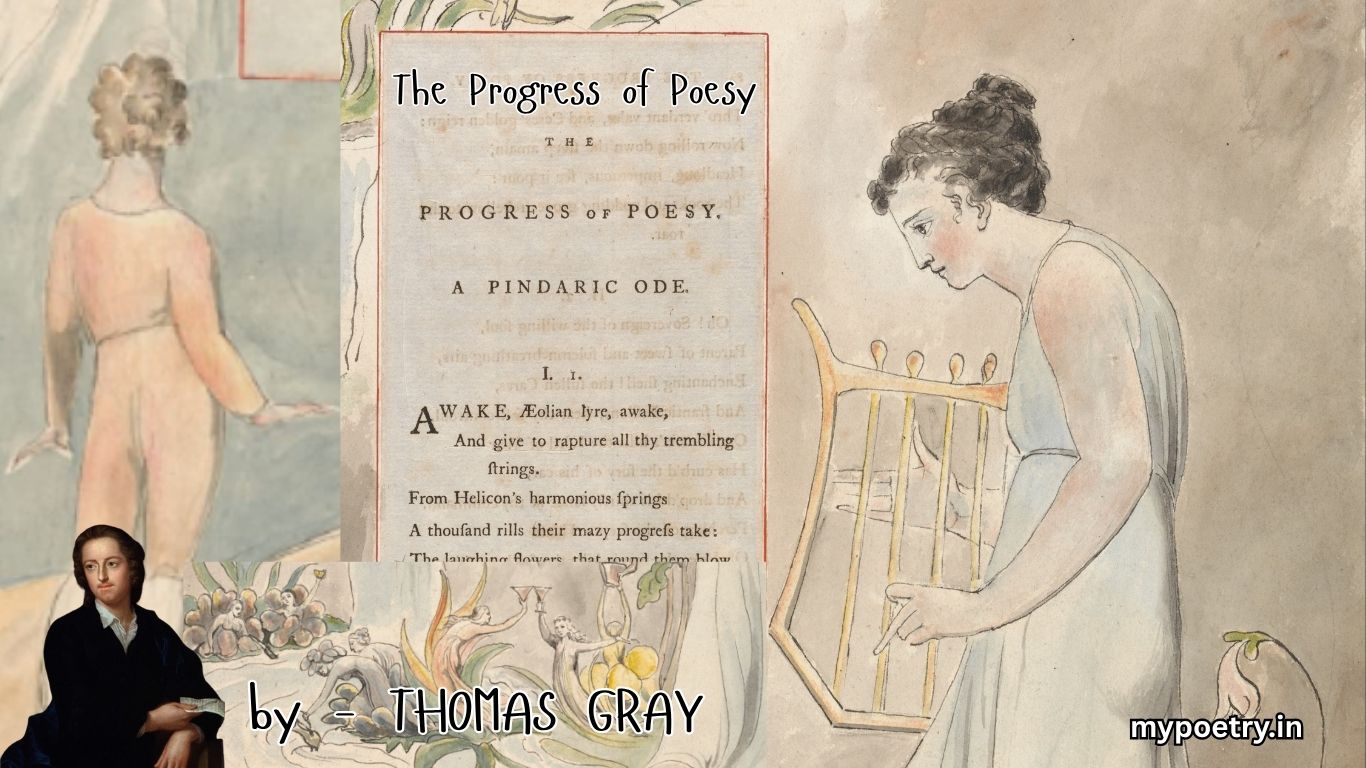
I.1. Lines 1-12
Awake, Æolian lyre, awake,
And give to rapture all thy trembling strings.
From Helicon’s harmonious springs
A thousand rills their mazy progress take:
The laughing flowers, that round them blow,
Drink life and fragrance as they flow.
Now the rich stream of music winds along
Deep, majestic, smooth, and strong,
Thro’ verdant vales, and Ceres’ golden reign:
Now rolling down the steep amain,
Headlong, impetuous, see it pour:
The rocks and nodding groves rebellow to the roar.
Wake up, my singing lyre, wake up, and let your throbbing strings produce sounds of delight. From Helicon, which is the poetical fountain sacred to the Muses, there originate a thousand brooks which set out on their zig-zag course. The happy flowers which bloom around them receive their nourishment and their sweet smells from these brooks as they flow onwards. The rich stream of music follows its tortuous course, sometimes through green and fertile valleys and the fields of ripe corn presided over by Ceres, the goddess of the earth, and then it produces deep, majestic, smooth, and strong sounds. And sometimes the stream rolls with great force, down mountain-slopes and may be seen rushing with tremendous vigour and speed, and in a reckless manner*. The rocks and the waving trees reply to the roar of the stream in the form of echoes.
The Source of Poetry, and Kinds of Poetry
CRITICAL SUMMARY– Poetry has its source in the fountains of Mount Helicon. Poetry gives and lustre to all ti touches. Its quiet majestic flow enriches every subject; sometimes its course becomes rapid and irresistible. In other words, poetry may employ description and reflection, or it may deal with turbulent passions. It is a combination of music and language. ( Lines 1-12)
COMMENT– what Gray means to say is that the imagination as manifested in poetry transforms the world of ordinary vision. Gray expresses himself by making use of the ancient Greek myth regarding Mount helicon which was sacred to the Muses. The idea is expressed in metaphorical language, poetry being compared to a thousand streams flowing onwards from their source. Two distinct kinds of poetry are specified – one, deep and majestic ; the other, headlong and impetuous.
I.2. (Lines 13-24)
Oh! Sovereign of the willing soul,
Parent of sweet and solemn-breathing airs,
Enchanting shell! the sullen Cares
And frantic Passions hear thy soft control.
On Thracia’s hills the Lord of War,
Has curb’d the fury of his car,
And dropp’d his thirsty lance at thy command.
Perching on the sceptred hand
Of Jove, thy magic lulls the feather’d king
With ruffled plumes and flagging wing:
Quench’d in dark clouds of slumber lie
The terror of his beak, and light’nings of his eye.
Oh, Muse ! You are a producer of sweet and solemn notes of music, and you have perfect dominion over the human heart which willingly bows to you! The lyre, on which you play, gives out enchanting sounds. The annoying cares and the wild passions of human beings are brought under control by your gentle influence. Mars, the god of war, hears your voice on the hills of Thracia, his home, and restrains his tempestuous chariot, dropping his blood-thirsty spear because you have commanded him not to fight. On the sceptre-bearing hand of Jove sits Jove’s eagle. Your magic has the power to tranquillize the wild eagle which then has drooping plumes and halting wings. As the eagle listens to your voice, the terror of his cruel beak and the glitter of his fierce eyes are subdued as if lost in the thick folds of sleep.
Poetry can control human emotions
Addressing the Muse of poetry, Gray says that with its sweet and solemn sounds, it exercises full control over the human heart. Lyrical poetry can subdue the frantic passions and soothe the sullen cares of man. It has the power to restrain the god of war from pursuing his war-like course. It can keep in check the fierce eagle of Jove. ( Lines 13-24)
COMMENT– The idea that poetry can curb the raging passions of the human soul is well known. (Dryden said the same thing about music in his Alexander’s Feast and ode on St. Cecilia’s Day). Gray illustrates his idea with reference to Mars ( the god of wars) , and the eagle which was Jove’s favourite bird. The picture of the eagle (“the feathered eagle”) is very vivid, but the use of the word “quenched” for “the terror” of the eagle’s beak has been objected to by critics.
I.3. (Lines 25-41)
Thee the voice, the dance, obey,
Temper’d to thy warbled lay.
O’er Idalia’s velvet-green
The rosy-crowned Loves are seen
On Cytherea’s day
With antic Sports and blue-ey’d Pleasures,
Frisking light in frolic measures;
Now pursuing, now retreating,
Now in circling troops they meet:
To brisk notes in cadence beating
Glance their many-twinkling feet.
Slow melting strains their Queen’s approach declare:
Where’er she turns the Graces homage pay.
With arms sublime, that float upon the air,
In gliding state she wins her easy way:
O’er her warm cheek and rising bosom move
The bloom of young Desire and purple light of Love.
The human voice and the dancing movements of .the human body obey you, O Muse, and attune themselves to the song sung by you. The winged Cupids, who attend upon Venus, and who wear crowns of roses, may be seen on the velvet-green fields of Idalia (in Cyprus). On the day which is sacred to Venus, these Cupids are seen in the company of grotesque, merry figures and blue-eyed personifications of pleasure leaping about with light and carefree steps. Sometimes they chase one another, sometimes they move backwards, and sometimes they come together in a large circle. Their feet, in their glittering variety, move rhythmically in a dance keping step with quick music. Slow and soft notes of music announce the approach of their queen, Venus. The daughters* of Zeus pay their homage 10 her in whichever direction she may turn. She walks with smooth and effortless steps, as if she were gliding, with her arms raised upward and floating upon the air. The bloom of youthful Desire and the rosy red light of Love hover over her warm cheeks and rising breast.
Poetry makes lovers dance joyfully
The human voice and the dancing movements of the human body obey the Muse of Poetry. The winged cupids, who attend upon Venus, dance merrily in the company of Sports and Pleasures to the rhythm of brisk notes. The three Graces pay their homage to Venus who moves about with gliding steps and with her arms raised upwards. Love and desire appear on her face as bosom. In short, poetry makes young lovers dance joyfully and infuses love and desire into their hearts.
COMMENT– We have a number of personifications in these lines- Loves, sports, Pleasures , Graces and desire. Personfications were one of the principal features of 18th century poetry. The idea is here is that poetry arouses. The feelings of love in the human heart. The picture of lovers dancing under the patronage of Venus is most exquisitely(charmingly) sensuous (sensual).
II.1. 42-45
Man’s feeble race what ills await,
Labour, and Penury, the racks of Pain,
Disease, and Sorrow’s weeping train,
And Death, sad refuge from the storms of Fate!
How many are the evils that lie in wait for the helpless race of human beings! These evils include hard toil, extreme poverty, the acute pangs of physical suffering, disease, the tearful misfortunes which follow close at the heels of sorrow, and death which is a tragic fact even though it provides an escape from the assaults of fate.
46-53
The fond complaint, my song, disprove,
And justify the laws of Jove.
Say, has he giv’n in vain the heav’nly Muse?
Night, and all her sickly dews,
Her spectres wan, and birds of boding cry,
He gives to range the dreary sky:
Till down the eastern cliffs afar
Hyperion’s march they spy, and glitt’ring shafts of war.
O my poetic composition! Show that this complaint against human life is foolish and false, and prove that the laws, by which God governs human beings, are just. Tell my readers whether Providence has bestowed the heavenly Muse of poetry upon human beings in vain or whether the Muse compensates the human race for all the evils of life. When night comes, all its unhealthy (or unwholesome) vapours, its pale ghosts, and its bird whose cry is an omen of some coming misfortune, are permitted by Providence to roam about in the gloomy desolation of the sky. But all these flee when they see, over the distant mountains of the east, the rising of the sun which, with its radiant beams, wages war upon the darkness and terrors of the night
Poetry is a compensation to human beings for all their ills
Many are the evils that lie in wait for human beings. These evils include hard toil, extreme poverty, sorrow, and death. Human complaints against these evils are , however, unjustified. Poetry can prove that the laws by which Providence governs human life are just . Providence has bestowed the heavenly Muse of poetry upon human beings as a comprensation to them for all their ills. What sunrise to the terrors of night, so is poetry to the evils of human life.
COMMENT-the idea is here fairly convincing though we must allow for the element of exaggeration in the way it has been expressed. Not all readers will, however, accept the view that poetry is an adequate compensation for all the ills of life. The abundant use of personifications – Labour, Penury, Pain, Sorrow, Fate – is to be noted. The line – And Justify the laws of Jove ” is reminiscent of Milton’s purpose to justify the ways of God to man.
II.2.
54-57
In climes beyond the solar road,
Where shaggy forms o’er ice-built mountains roam,
The Muse has broke the twilight-gloom
To cheer the shiv’ring native’s dull abode.
In the remote Arctic regions, beyond the path of the sun, where fur-clad nativest roam over ice-covered mountains, the Muse of poetry has dispelled the semi-darkness of the twilight in order to provide some entertainment to the shivering natives in their cheerless dwellings.
58-62
And oft, beneath the od’rous shade
Of Chili’s boundless forests laid,
She deigns to hear the savage youth repeat
In loose numbers wildly sweet
Their feather-cinctur’d chiefs, and dusky loves.
And often, in the fragrant shade of the vast Chilean forests, the Muse lies down and feels pleased to hear the barbarian young men recite wild but sweet verses, neither following a rigid metrical pattern nor rigorously inter-connected, in honour of their dark-complexioned sweethearts and their tribal chiefs wearing girdles of feathers.
63-65
Her track, where’er the goddess roves,
Glory pursue, and generous Shame,
Th’ unconquerable Mind, and Freedom’s holy flame.
Wherever the Muse of poetry travels, the path traversed by her may be recognized becarse it is followed by glory, by a rightful sense of what is dishonourable, by minds that cannot be enslaved, and by the sacred flame of liberty.
Poetry among savages and barbarians
The muse of poetry provides entertainment to the fur-clad natives of the cold Arctic regions. The Barbarian young men recite wild but sweet verses in the shade of Chilean forests. They sing these verses in honour of their dark-complexioned sweethearts and their tribal chiefs. The muse of the Poetry is everywhere followed by glory, a sense of honour, and a love of liberty.
COMMENT– These lines describe the extensive influence, of poetry over the remotest and the most uncivilzed nations of the world . A connection is also established here between poetry and liberty, and between poetry and a love of virtue and goodness.
II.3.
66-72
Woods, that wave o’er Delphi’s steep,
Isles, that crown th’ Ægean deep,
Fields, that cool Ilissus laves,
Or where Mæander’s amber waves
In ling’ring Lab’rinths creep,
How do your tuneful echoes languish,
Mute, but to the voice of Anguish?
Poetry once flourished in woods growing, and swaying upon, Mount Parnassus where was situated the oracular shrine of Apollo at Delphi. It flourished in the islands of the Aegean Sea. It flourished in the fields washed by the cool waters of the river Ilissus, and in the region through which flowed the slow, muddy waters of the river Meander following a zigzag course*. But no more do these homes of poetry ring with musical echoes.
They are silent and, if at all they send any echoes, it is to the voices of sorrow and pain.
73-78
Where each old poetic mountain
Inspiration breath’d around:
Ev’ry shade and hallow’d Fountain
Murmur’d deep a solemn sound:
Till the sad Nine in Greece’s evil hour
Left their Parnassus for the Latian plains.
Each old mountain in these regions was pregnant with poetry and served as a source of inspiration to poets. Every shade and every sacred fountain there was a source of deep, solemn, and murmuring sounds of poetry till, upon the loss of freedom by Greece, the nine Muses, feeling overcome by grief, gave up their abode on Mount Parnassus, and moved to the plains of Italy.
79-82
Alike they scorn the pomp of tyrant Power,
And coward Vice, that revels in her chains.
When Latium had her lofty spirit lost,
They sought, O Albion! next thy sea-encircled coast.
The Muses felt equally scornful of the proud display of tyrannical power of Italian rulers, and they disapproved of the cowardly and sinful people who enjoyed their very slavery. Therefore, when Rome lost its noble spirit, the Muses sought the British Isles as their refuge
The “Progress” of poetry from Greece to Italy, and from Italy to Britain
Poetry once flourished near the shrine of Apollo at Delphi. It Flourished on the islands of the Aegean sea, and and in the fields lying close to the river Ilissus, and the river Maeander. But those homes of poetry became silend when Greece lost her independence. The Muses then moved to the plains of Italy. Feeling scornful of the tyrannical rule (Cruel and oppressive rule) by a dictator of Italian dictators, the Muses sought the British isles (islands).
- Contempt: अवमानना, तिरस्कार, घृणा, अपमान।
- Disdain: अवहेलना, उपेक्षा, तुच्छ समझना, तिरस्कार करना।
COMMENT– Here Gray refers to the Greek god of poetry and to the Birth-places of Greek poets who achieved the fame. After mentioning the oracle of Apollo at Delphi, he specifies the Aegean Islands of Delos, Lesbos, and Cos, associated with Apollo, Alcaeus and Saphho, and Simonides respectively. From Greece, poetry travelled to Britain via Italy. The theme here is the civilizing influence of the imagination as manifested in poetry. The link between poetry and liberty is once again emphasized.
III.1.
83-88
Far from the sun and summer-gale,
In thy green lap was Nature’s darling laid,
What time, where lucid Avon stray’d,
To him the mighty Mother did unveil
Her awful face: the dauntless child
Stretch’d forth his little arms, and smiled.
Shakespeare, the favourite of Nature, was born in the green plains of Britain, far away from the heat of the tropical sun and far from the storms of summer. That was the time when the mighty Mother, Nature, revealed her terrifying and stern face to him at Stratford on the banks of the river Avon, the water of which is clear and transparent. The child Shakespeare remained unafraid after seeing the awful mystery of Nature and, spreading his little arms, smiled at the sight.
89-94
This pencil take (she said) whose colours clear
Richly paint the vernal year:
Thine too these golden keys, immortal boy!
This can unlock the gates of Joy;
Of Horror that, and thrilling Fears,
Or ope the sacred source of sympathetic tears.
Nature spoke to Shakespeare thus: “Take this pencil with the clear colours of which you will be able to write rich descriptions of the beauties of spring. Take these golden keys also, you immortal Boy! Here is a key which will enable you to open the locks of the gates of joy. And here is another key with which you can open the gates of horror and thrilling terror, or the gates of sacred and sympathetic tears.
The greatness of Shakespeare
Shakespeare, the favourite of Nature, was born at Stratford on the banks of the river Avon. nature revealed her terrifying and stern face to him, but Shakespeare remained unafraid after seeing it. Nature bestowed on Shakespeare the gift of Nature-description, the gift of writing joyful comedies, and the gift of writing thrilling and painful tragedies.
Comment – Gray here pays a tribute to the greatness of Shakespeare as a poet-dramatist. Shakespeare’s natural genius as distinguished from acquired learning is recognized by Gray.
III.2.
95-101
Nor second he, that rode sublime
Upon the seraph-wings of Ecstasy,
The secrets of th’ Abyss to spy.
He pass’d the flaming bounds of Place and Time:
The living throne, the sapphire-blaze,
Where angels tremble, while they gaze,
He saw; but blasted with excess of light,
seraph-wings – angelic wings
Abyss– bottomless pit
blasted– dazzled, struck blind
Then there was Milton who was second to none (in the sphere of epic poetry. He soared to great heights upon the angel-wings of poetic inspiration in order to probe the mysteries of the limitless region known as Chaos. He ascended above the fiery walls of this earthly world of time and space, and he saw God’s flaming throne which looked like a sapphire and, while gazing at which, the angels trembled with fear of the Lord. Milton saw that throne but, dazzled by the excessive light of it, he became blind and lost his eye-sight for ever.*
102-106
Clos’d his eyes in endless night.
Behold, where Dryden’s less presumptuous car,
Wide o’er the fields of Glory bear
Two coursers of ethereal race,
With necks in thunder cloth’d, and long-resounding pace.
long-resounding pace – producing sounds which are heard for a long time
ethereal – heavenly
presumptuous– less ambitious
Look at Dryden’s less ambitious chariot being drawn over fields of fame and renown by two horses of celestial descent, with their necks clothed in thunder and travelling with great vigour at a pace the echoes of which are heard for a long time.
Milton and Dryden
Milton was the greatest epic poet. He soared to great heights in order to probe the secrets of the universe. He travelled beyond the world of time and place and saw God’s flaming throne the brightness of which dazzled and blinded him. Then appeared Dryden who was less ambitious and who made a thunderous and rhetorical use of the heroic couplet.
COMMENT– The greatness of Milton and Dryden is here dwelt upon in highly figurative language. The particular excellences of both poets are specified.
III.3.
107-111
Hark, his hands thy lyre explore!
Bright-eyed Fancy hovering o’er
Scatters from her pictur’d urn
Thoughts that breathe, and words that burn.
But ah! ’tis heard no more—
hark – listen
Listen! Dryden is now trying the possibilities of lyrical poetry. The poetic imagination, which is keen and clear, hovers over Dryden and from its beautiful store provides him with thoughts that have life and vitality, and words that have force and fire. But alas! the voice of Dryden can be heard no more (i.e. Dryden too is silent now.
112-123
O lyre divine, what daring spirit
Wakes thee now? tho’ he inherit
Nor the pride, nor ample pinion,
That the Theban Eagle bear,
Sailing with supreme dominion
Thro’ the azure deep of air:
Yet oft before his infant eyes would run
Such forms, as glitter in the Muse’s ray
With orient hues, unborrow’d of the Sun:
Yet shall he mount, and keep his distant way
Beyond the limits of a vulgar fate,
Beneath the good how far—but far above the great.
O divine lyrical poetry, who is the courageous poet now trying his hand upon you ?it I am myself that poet. Although I have inherited neither the magnificence nor the large wings which carried the Theban poet, Pindar, and enabled him to flyttt smoothly and with supreme self-confidence through the vast regions of the blue sky, yet often as a child I saw such shapes floating before my eyes as shine in the light of the Muse with richly bright colours and are not drived from other masters of poetry.
These shapes were native to my own genius. In spite of my limitations I shall keep writing poems, maintaining a distant course and avoiding the fate that is in store for inferior poets. My position will be far higher than that of persons who are regarded as “great” in the worldly sense; but I shall be far below those who are worthy or noble in the moral sense.
pride – magnificence,
prinion– , wing
theban eagle– pinda the greek poet,
air– blue sea of air; boundless regions of air and sky ,
orient– bright, shining ,
mount– soar
Self-assessment
Dryden wrote lyrical poetry also, but now he too has become mute. Gray is the enxt writer to try his hand on lyrical poetry. Gray does not have the magnificence of Pindar, but as a child Gray saw certain poetic visions which his position will be above those who are great in the wordly sense though below those are morally noble.
COMMENT– In the concluding portion of the poem Gray turns to himself. He rightly claims that he is gifted with the true poet’s imaginative view of reality, and he states the rank of the poet in the scale of values- above the merely ‘great’ but of less significance that the virtuous. (The whole poem answers the questions ; “what is poetry?” and “What is the value of Poetry?”)
CRITICAL APPRECIATION
The Lineage of poetry
The Progress of Poesy belongs to one of the most popular poetic genres of the 17th and 18th centuries, a genre which flourished as the Augustans developed a historical perspective that established them as the heirs in a direct line of succession from the civilizations of ancient Greece and Rome.
The purpose of the “progress poem” was to expound this genealogy, tracing back their arts and virtues to Greece and then describing the continuous historical and geographical progress westward to Britain. The route could show minor variations, but usually proceeded through Rome and medieval Italy. The reason for the steady progress of the arts to Britain was usually (as in The Progress of Poesy Lines 77-82) the decline of liberty in the former cultural centres of the world. Only in Britain was true liberty to be found, according to the Augustans, so that the arts had inevitably settled down there.
The route followed by liberty itself to Britain is explicitly described in such progress poems as Thomson’s Liberty and Collins’s Ode to Liberty. A number of Collins’s other odes belong to the genre of “progress poems”.
Nevertheless, by the mid-18th century the patriotic conviction that the classical arts and virtues had not merely been transmitted to Britain but had thrived there as never before was losing some of its confidence. That the sense of the past out of which the “progress poem” sprang could induce in this new generation a sense of inferiority rather than simple complacency is clear from the conclusion of Gray’s The Progress of Poesy and from Collins’s Ode on the Poetical Character.
Thomas Gray’s conception of poetry
In The Progress of Poesy, Gray celebrates and affirms the nature of poetry and its value. To make clear his purpose, he wrote an analysis of each stanza for the 1768 edition, and this prose commentary should be read carefully. His title-“The Progress”-indicates that he is dealing with the development of poetry historically and with the geographical movement of the haunts of the Muse from Greece to Italy to England. (Collins includes such “progress” material in many of his odes.) Gray begins by defining poetry in an image of a stream. His stanza is itself an example of how such an
“otherwise dry and barren” thing as a definition is given “life and lustre” and
“enriched” by “pomp of diction and luxuriant harmony of numbers”. Gray. does not use the word “imagination”, but he implies that it is the imagination as manifested in poetry that transforms the world of ordinary vision. He returns to this in his last stanza, where he records his own imaginative visions of
Such forms, as glitter in the Muse’s ray
With orient hues, unborrow’d of the Sun.
In addition his first stanza images two contrasting kinds of poetry-that of passion and that of description and reflection. Then, after the manner of the Greeks, seeing poetry as a combination of music and language, he turns to the powers of harmony to soothe the cares and passions of man’s soul and to imbue the body with its own grace of movement. This section ends with the second strophe in which he states and then images his theme that poetry has the power to compensate for and assuage the evils which man is subjected to.
The poem is a “justification” for poetry.
Thomas Gray’s Survey
The argument continues by invoking historical “proofs” of the omnipresence of poetry, its association with political freedom and manly virtues, and its progress from Greece via Italy to England. The theme is the civilizing influence of the imagination. With the last strophe he begins to celebrate Shakespeare, Milton, and Dryden, and by characterizing their particular poetry, to suggest additional “values” of poetry to man. But these
“values” are further extensions of the ones suggested earlier in the poem— poetry as transforming ordinary vision (“Richly paint the vernal year”), as moving the passions, as “prophetic” ,as harmony. Finally, he turns to the present, to the lack of any poet of Dryden’s stature, and to himself, gifted with the true poet’s imaginative view of reality, and to his statement of the place of the poet in the scale of values— above the merely “great”, but of less significance than the virtuous. The whole poem faces the questions “What is poetry?” and “What is its value?” Its closest equivalent in the period is Collins’s Ode on the Poetical Character.
Pictorial effects; and the Pindaric Technique.
In manner, The Progress of Poesy is a series of pictures: in fact the third strophe suggested a picture to Romney*.
Each stanza creates a visual situation that could be pictorially reproduced. Equally, each stanza embodies movement-for example, Hyperion marching down the eastern ciiffs and contrast-for example, between Night and Dawn, the Spectres and Hyperion, in the second strophe.
The pictorial description creates images— as, for example, of the Eagle on Jove’s wrist soothed to sleep by music-Which carry their own meaning. But Gray is not being unlike Pindar when he changes his style to include general observations—”Man’s feeble race what ills await”-or to expound his argument in another type of heightened language:
The fond complaint, my song, disprove,
And justify the laws of Jove.
He matches Pindar in his variety of subject-matter, his rapidity, his sonority(melody), his nobility of concept, and his dignity of style. His two Pindarics are for readers experienced in the ways of poetry. They do not suddenly overwhelm the reader; their enjoyment demands an understanding of the nature of Poetry.