Usually the period after the Middle Age, or so called Dark Age, is known as Renaissance (rebirth); the period is regarded as transitional period; that is to say, a new worldview predominated in England. Reformation, explorations and new scientific developments highly influenced the mind of the English people. With the rise of Protestantism, for instance, faith and salvation was deemed to be a matter of individual’s direct transaction with God without the church’s intrusion. As a result, Protestantism is regarded to be an “extreme manifestation of Renaissance individualism”.
Read Full texts of the paper 102 – Click here
However, humanism can be the most influential force in transforming the worldview of the Renaissance man. A humanist was one who received education in rhetoric, grammar and logic and was less engaged in
theological aspects of existence.
The core of humanist education was classical culture – Greek and Roman sources. Moreover, humanist movement emphasized on the power of man’s in learning and exalted all around knowledgeable mankind.
Therefore, instead of viewing human being as corrupt and static in his position in the Medieval chain of being and instead of stressing otherworldly reward for the miserable man of the Middle age, humanism under the effect of pagan culture and literature emphasized on an aspiring man’s capability to transcend his position in the great chain of being through learning and on “the values achievable by human beings in this world rather than in an afterlife”.
Hence, these two traits, individualism and worldliness, manifested themselves in culture and literature of the age in diverse forms such as: a great yearning for unlimited knowledge and learning, an exceptional love of beauty and craving for the sensual pleasures of life, and an sky-high ambition for power and adventure. To sum up, central to this age is the concept of Renaissance man – Gentleman: a man of humble origin who is well developed in all fields of knowledge – physical, philosophical and artistic – and aspire to high position.
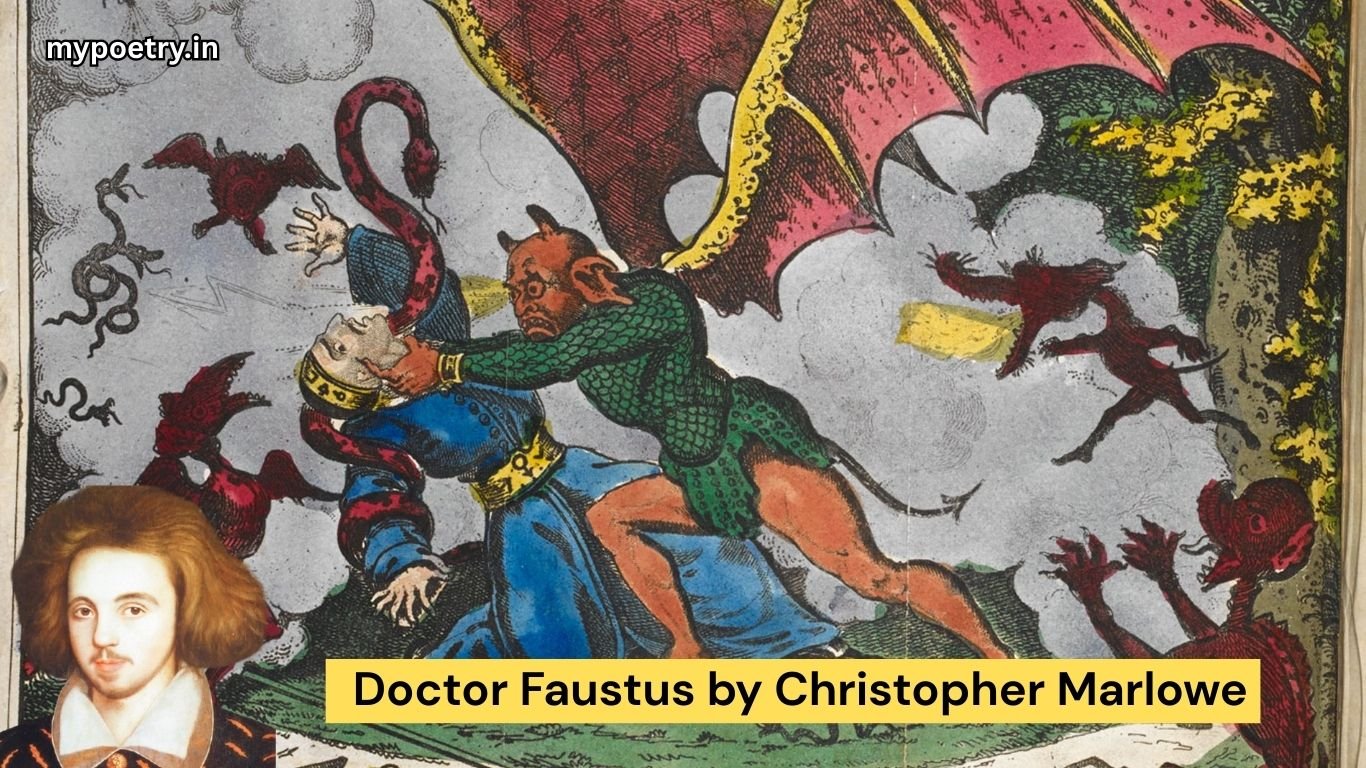
Christopher Marlowe (1564-1593) is a prominent Renaissance writer who received a Classical education in grammar schools and got his MA degree from the University of Cambridge. His Tragical History of the Life and Death of Doctor Faustus was a great success. One of the sources of his play is Faustian motif, implying a situation in which an ambitious person sells his soul (or surrender his moral basis) in order to achieve infinite knowledge and power for a limit life span.
This tragedy shows the life-story of Dr. Faustus, a man of humble origin who has reach to the summit of all
classical fields of study. Dissatisfied with limitations of all of these fields – including theology – he commits himself to evil and to the art of necromancy in exchange of his soul for twenty-four years to achieve infinite knowledge of the world and infinite power (especially for his country. Accordingly, Faustus abjures(rejects) God “in the hope of becoming something more than a man” (Routledge 32).
At first, he has noble goals: he wants to gain more knowledge about the working of the world, its Cause, and he wishes to make his country the most powerful country in the world. As the time passes, instead of clinging to his noble power, he commit himself to some practical jokes and to the entertainment of aristocrats.
What is at stake is that in his inner conflict between repentance and worldly desires, he always
perceive the door to the salvation closed to himself, and consequently engrosses himself in the pleasures of the world. He sees himself damned and beyond God’s forgiveness. After twenty-four years, incapable of repentance Faustus finds himself exposed to eternal pain and Lucifer claims his soul. Considering this brief introduction, the objective of this study is to address Marlowe’s Dr. Faustus as the tragedy of the
Renaissance man.
DR. FAUSTUS: A TRAGEDY OF RENAISSANCE MAN
The play begins with the prologue announcing that this tragedy is not about an aristocrat or a man of high position but about Faustus, a man of humble origin and a scholar. He quickly received his doctoral degree. However, because of his self-conceit, of his Icarusian ambition for infinite knowledge, he “surfeits upon
cursed necromancy” (25). Here, we can detect Faustus exemplifying a Renaissance man (gentleman).
He is a typical Renaissance individual who rises from nothing to power, but as the allusion Icarus’s myth and sin of gluttony – overconsumption of knowledge and power – foreshadows that the excessive ambition and hubris of the individual will lead to his downfall.
The first scene shows Faustus examining every field of knowledge. He has mastered all fields of study from philosophy to medicine. Even Theology has no answer for his insatiable desire for knowledge: he reads the Bible and reasons that all men are sinner. Therefore, disgusted with this logic, he turns to practice of magic.
Faustus is very learned and confident in his intelligent, yet paradoxically his dismissal of all ordinary areas of learning is contingent upon his logic. In his blindness, he neglects what follows after the part he reads from the inference “the gift of God is eternal life’. This blindness to God’s grace and his avoid sin that sin and hell are inevitable foreshadows his future inability to avoid sin and repentance.
What follows is that Faustus in his conflict between the limitation of human knowledge and desire to transcend his position in the universe chooses the irt of necromancy and decides to tire his “brains to gain a deity” (62).
Faustus seems to be a self-reliant individual in his abilities, yet ironically he till relies on the help of the others, Valdes and Cornelius. Faustus feels the imitation of human knowledge and its futility. That is why he turns to magic to discover power and knowledge. For Faustus, “necromantic books are heavenly” (49). This is the inversion of the cosmos: making black magic heavenly and religious. Central to world picture of Renaissance period is the concept of order: one who strives to change the order of the things, to disharmonize the harmony and balance of the world is condemned to fall.
Now that, Faustus is determined to increase his knowledge and power he summons Mephistopheles, Lucifer’s servant, to give him supreme power and knowledge in exchange of twenty-four years. After this span, Lucifer can claim his soul. The first appearance of Mephistopheles and Lucifer, and the terms of the deal are significant and ironical.
Mephistopheles and Lucifer are symbols of excessive pride and of forbidden knowledge. When Mephistopheles appears to Faustus, he is ugly. It firstly implies that hell is a place of damnation and of horror and anything there is ugly. This should be a warning to Faustus. Faustus takes his first step towards his damnation as he renounces the Trinity and God, and appeals to the power of hell. What is significant here is that even hell has its own hierarchy as Mephistopheles says “I am a servant to great Lucifer”. That is to say, supreme power and transcendence is the illusion of Faustus. Moreover, Faustus thinks it is his power of magic that made Mephistopheles obedient to him.
Faustus’s first concern is to expand his knowledge about hell.
Mephistopheles’s speech about Lucifer displays that his falls due to arrogance and pride and sin without the possibility of redemption. This foreshadows the fall of arrogant Faustus. Mephistopheles says that “threw Lucifer from the face of heaven”. It shows that Lucifer is less powerful than God. It shows transcendence beyond his position through the knowledge which Lucifer provides him is an allusion.
In Renaissance World view, the universe is governed by the principles of law and order. Faustus has the
illusion that he can cancel out this order of things and becomes a powerful god.
Faustus freely choose to bargain with Lucifer, to surrender up to him his soul with this condition that Lucifer spares “four and twenty years, letting him live in all voluptuousness“. In fact this twenty four years passes like twenty four hours, a day. What Faustus desires is wholeness; to put it simply, he wants to develop all of his faculties and talents and achieve all the knowledge he is capable of.
In different situations, Faustus considers turning to God and to repent, but ultimately he rejects the idea. For instance, in face of Good Angel and Bad Angel, he rejects the offerings of heaven and pursues honor and wealth which are offered by Bad Angel.
Therefore, he leaves spiritual and moral issues and follows material desires of own, and the fact that he signs the document with his own blood stands for Faustus’s total commitment to aspire to earthly power to the exclusion of otherworldly matters. Therefore, we can consider Faustus a tragic hero whose hamartia is his blindness to the illusion of total power and knowledge.
After the deal with Lucifer is legalized Faustus’s first question is about heaven, hell and God. For Mephistopheles, everywhere that God is absent is Hell. On the other hand, Faustus-rejects hell as being a fable. This shows Faustus’s skepticism and the fallacy of his logic. He has lost his senses; he does not understand that Mephistopheles is the obvious example of hell. Moreover, Faustus is blind to the fact that his noble requests are not fulfilled according to the terms of the pact: neither his desire for supreme
knowledge, nor his other desires are fulfilled completely. However, under the illusion of power and knowledge Faustus noble goals transform to trivial and cheap demands (such as a wife) or practical jokes (the case of the Pope, horse and so on).
Arriving at Rome, Faustus wants to see the monuments and to expand his knowledge. He thus continues to gather knowledge far beyond the normal scope of experience. In fact, he has the highest ambition of a Renaissance man for knowledge.
However, Mephistopheles persuades him to stay at the Pope’s chamber to play them some cheap tricks. This shows that Faustus’s lofty ambitions are degraded to baser desires.
In scene seven, we can find out that Faustus’s newly found knowledge has to some extent brought him power and prestige. Magic has allowed him to ise even further through social ranks, gaining an invitation to the royal court. Yet it is not true to regard this as true power. Faustus is here like an entertainer.
In the scene eight, there is an ironical analogy between Alexander the Great and Faustus: Alexander represents the epitome of a powerful individual, who through his human power conquered the world. Faustus has achieved his power through magic, but there is a distinction between former grandeur of his ambition (to be a powerful king like Alexander) and his behavior as a court entertainer. Ironically, Faustus can surpass Alexander, but he merely preforms some cheap tricks. Moreover, even in his thing,
magic, he is not excellent.
When he is asked to summon the real Alexander, he confesses that “it is not my ability to present before…. Which long since are consumed to dust”. All he can perform is to provide illusions, Therefore, Knowledge (of magic) just brought him the illusion of power, not the real power.
In scene eleven, Faustus provides the duchess a dish of ripe grapes. Once again Faustus’s great powers are put for trifles. Now that he has a great power and knowledge, he spends his time carrying trivial demands of others. Faustus has lost his hold on grandeur and has become pathetic. Perhaps this issue has multiple meanings: on the one hand it may imply the nature of pact with Lucifer that one cannot gain all he wants. On the other hand, it may signify a criticism of worldly opinion and the entire modern project of Renaissance which pushes God behind the veil and tries to dominate nature and society. As we can see the ultimate goals of Faustus for knowledge and power which was started by breaking with God, has
nothing for him except decadence and damnation.
The appearance of the Old Man in the final scene is also a matter of importance: the role of the Old Man which is a convention from medieval morality plays is to convince Faustus that he can repents and be saved due to Jesus Christ’s sacrifice. The Old Man is the reminiscent of the virtue of the Middle age when man was in close affinity with God. He is Faustus foil: both men are dying. While Faustus is young due to magic, his soul is blackened.
On the other hand, the Old Man has saved his soul. Unlike Faustus who is in despair and loose in his faith to God’s power and mercy, Old Man’s faith is stable. The appearance of Old Man shows that Faustus could achieve salvation through repentance. He could have defeated Evil like Old Man.
In this final scene, Faustus is very close to repentance, yet Lucifer and Mephistopheles chastise him for this. To dissuade himself, he commands Mephistopheles to bring him “that heavenly Helen … whose sweet embracing may extinguish” the thoughts of repentance. He request Helen to make him immortal with a kiss. At the moment of death he desires transcendence through physical affair. It contrasts with his first wish to achieve transcendence through magic and power and knowledge.
Faustus describes Helen the epitome of beauty and thinks that she can give him a soul, eternal life and salvation. It is ironic that Faustus thinks the Classical beauty can make him immortal through a kiss. He thinks with her he is in paradise. However, as Helen is an illusion, so Faustus’s desire is an illusion.
This may be a criticism of the learning of humanists and Renaissance which decenter God from the worldly affair and sought transcendence from their position in the chain of being through classical education. By decentering God, by destabilizing the divinity, they decentered and destabilized the self too.
This fact is shown by the attitude of the scholars who hear Faustus’s pact with the devil. They urge Faustus to repent because “God’s mercies are infinite‘. To scholars knowledge is valuable but not at the cost of abandoning and rejecting God.
At the moment of death Faustus is willing to burn his books. It symbolizes his willingness to abandon his desire for knowledge to be saved. However, it is late. The fact that Faustus is ready to burn his books shows the clash between Renaissance and medieval values.
Thirsts for infinite knowledge (a Renaissance virtue) is incompatible with Christianity. Knowledge can Christian with fetters. Thus, Faustus admits the Christian view. He condemns the knowledge which he sought for. The chorus urges that one should set limits to the desire for knowledge. This means that one shouldn’t goes beyond the normal order of the things and the limitations of humanity. Therefore, Faustus’s downfall is due to his own ambition.
CONCLUSION
Christopher Marlowe’s Dr. Faustus recounts the tragedy of Renaissance man. Dr. Faustus becomes the epitome of a Renaissance man who is disgusted with the medieval view of: a man who is passive in the world, a sinner man beyond redemption, a man without power who is under the control of his fate. This stagnant medieval man holds his inferior position in the world, sees the pains and misfortunes of this earthly world as his punishment for the sins of his First Parents, and seeks God’s grace for an otherworldly
reward.
On the other hand, Faustus, an exemplum of Renaissance man, rebels against this static and pathetic view of man. He wants to transcend his position the world. And to do so, the first step is to deny and decenter God from his dominant position. Man should be at core of earthly life and his desires should be satisfied. Consequently, earthly paradise rather than superlunary paradise should be built. However, transcending one’s position without gaining self-understanding and the knowledge of the world is impossible.
Therefore, education for all people was necessary in the Renaissance period and Faustus is the typical scholar of that time. However, Faustus realizes that this knowledge cannot truly soar the dignity of mankind.
Theology, philosophy, logic, medicine and so on are all pedagogical fields which were taught in the Middle age too. Something more is needed. For Faustus the answer is necromancy and the pact with Lucifer. Necromancy and the deal with Lucifer (a supernatural force) can gratify his tendency towards power and knowledge.
Yet Faustus blind to the fact that the subject of transcendence (superiority) or transition through learning is a Renaissance illusion. Neither his desire for power is fulfilled, nor does the knowledge he seek is the solution/Faustus is disillusioned through the final moment epiphany (abandoning his books)
when it is too late .
This shows the Renaissance Fallacy: elevating man’s position by disregarding morality and decentering God and focusing on man’s abilities has a huge cost: the tragic downfall of Renaissance man to a place much worse than the position of the medieval man. Moreover, if this study addresses the origin of the reasons of the catastrophes of twentieth century, World Wars, to this fallacy: excessive reliance on man’s capacity.