by – Edmund Spenser
Lines 1-4
One day I wrote her name upon the strand,
But came the waves and washed it away:
Again I write it with a second hand,
But came the tide, and made my pains his prey.
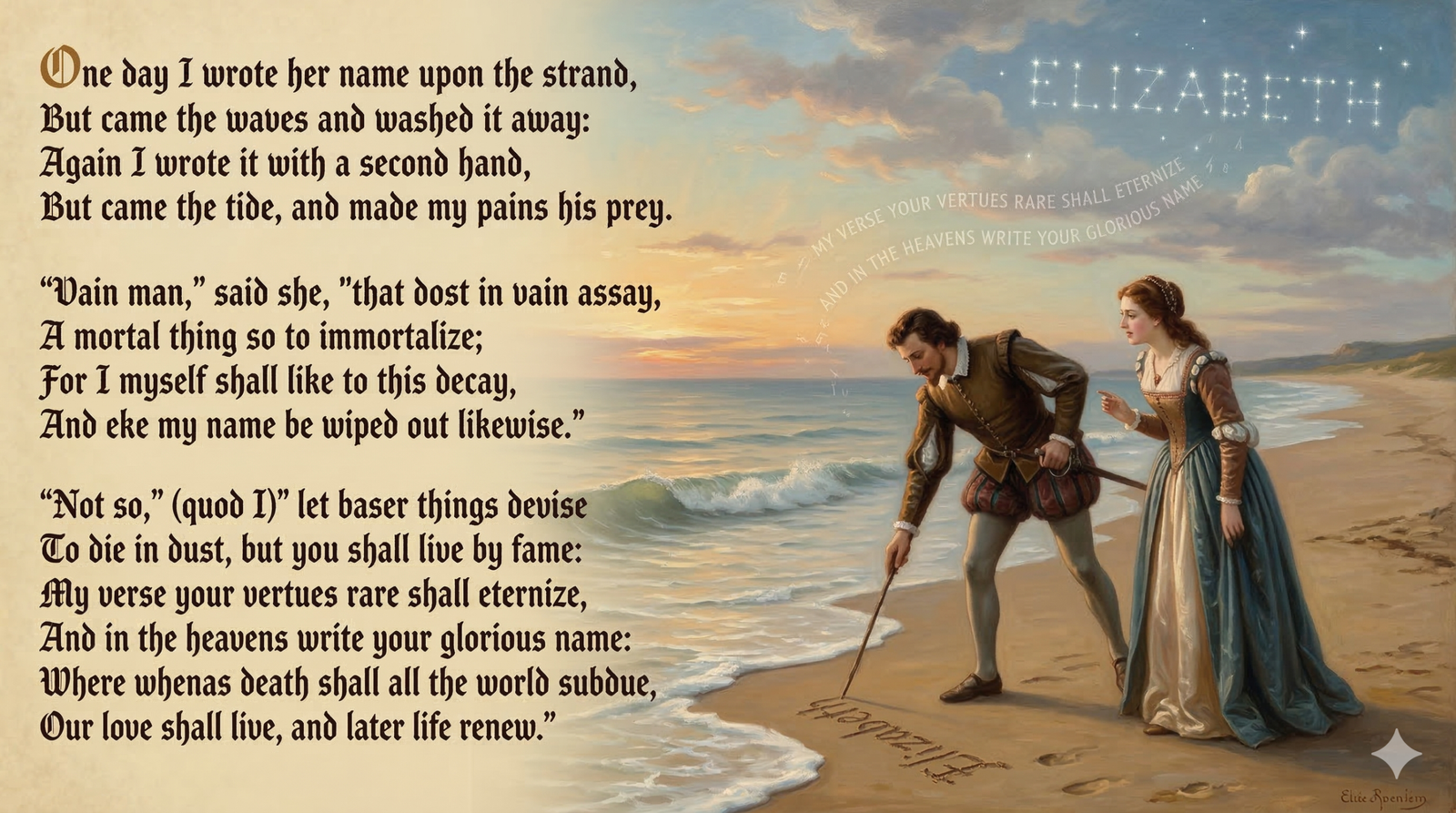
The opening quatrain of “Sonnet 75” shows the speaker’s effort to make his beloved live forever through poetry. It begins by establishing the setting: “One day.” The speaker scratches his loved one’s name into the beach sand, but the waves erase it (“I wrote her name upon the strand, But came the waves and washed it away“).
He tries again, rewriting it carefully (“Again I write it with a second hand, / But came the tide, and made my pains his prey”). The waves represent time’s power to wipe out human creations. This is highlighted through personification, as the waves actively “washed it away” and turned “my pains” into “his prey.” The speaker’s description of his writing as “my pains” also serves as a metaphor, illustrating the vulnerable bond between human endeavors and the forces of nature and time.
Lines 5-8
Vain man, said she, that doest in vain assay,
A mortal thing so to immortalize,
For I myself shall like to this decay,
And eek my name be wiped out likewise.
n the second quatrain, the speaker talks with his beloved. She calls him foolish: “Vain man, why try to make something mortal eternal?” She says people like her can’t live forever. She brings a fresh viewpoint, criticizing his silly efforts. Her name—and she herself—will fade away just like the sand writing (“For I myself shall like to this decay, / And eek my name be wiped out likewise”). Writing her name is pointless; time and nature wipe out everything human.
She reminds him: mortals vanish, just like waves erase sand words.
Lines 9-12
Not so, (quod I) let baser things devise
To die in dust, but you shall live by fame:
My verse, your virtues rare shall eternize,
And in the heavens write your glorious name.
The third quatrain shows the speaker’s comeback to his beloved. Here’s the big turn—the poem’s mood shifts. Before, both agreed everything mortal dies. Now, the speaker disagrees: “No way!” he says. Cheap things “baser things” can rot in dust, but you will live forever through fame (“Not so, quod I let baser things devise , To die in dust, but you shall live by fame”.
As a poet, he’ll make her eternal in his verses: “My verse, your virtues rare shall eternize, And in the heavens write your glorious name.” This lifts her to heaven with a “glorious name.” Poet power beats death—his words make her immortal in the stars.
Lines 13-14
Where whenas death shall all the world subdue,
Our love shall live, and later life renew.
The closing couplet wraps up the sonnet’s big idea. Even when death conquers the world , their love endures and revives in future lives.
It contrasts love’s eternity with life’s shortness—and death’s power. The whole poem feels melodic and steady thanks to its even rhyme scheme and iambic pentameter rhythm. This creates a calm, ear-pleasing flow with vivid images. Love outlasts death, thanks to poetry’s magic.
Downloadable PDF
Thanks for reading this poem analysis, Read further explanations too.